DELOITTE CONSULTING, LLP
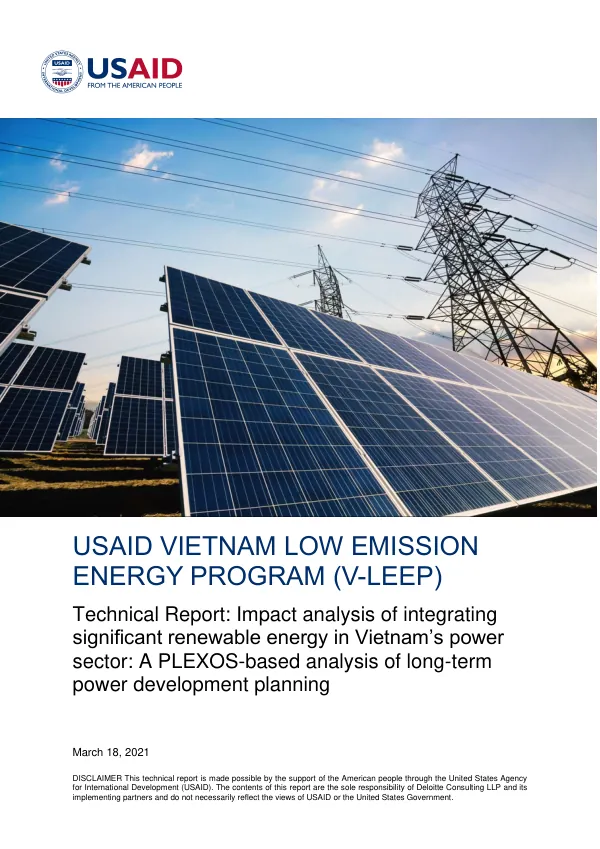
USAID V-LEEP TECHNICAL REPORT: A PLEXOS-BASED ANALYSIS OF LONG-TERM POWER PLANNING
The Vietnam Low Emission Energy Program (V-LEEP) is a technical report that provides an analysis of integrating significant renewable energy in Vietnam's power sector.
2021 · 89 pages
Sign in to readA free account is required to download.
Abstract
The report is based on a PLEXOS model, which is a long-term power development planning tool. The analysis aims to identify the potential impact of integrating renewable energy on Vietnam's power sector and provide recommendations for future planning. The report highlights the importance of integrating renewable energy in Vietnam's power sector to reduce greenhouse gas emissions and meet the country's Nationally Determined Commitments (NDCs). The analysis shows that integrating renewable energy can lead to significant reductions in emissions, with a potential reduction of up to 70% by 2045. The report also examines the potential impact of integrating renewable energy on the power sector's capacity, generation, and transmission. The analysis shows that integrating renewable energy can lead to an increase in installed capacity, with a potential increase of up to 30% by 2045. The report also highlights the importance of transmission infrastructure in supporting the integration of renewable energy, with a potential increase in transmission capacity of up to 20% by 2045. The report identifies several key findings, including the need for a more flexible and responsive power system to accommodate the variability of renewable energy sources. The analysis also highlights the importance of energy storage and demand-side management in supporting the integration of renewable energy. The report provides several recommendations for future planning, including the development of a more detailed and comprehensive power development plan that takes into account the integration of renewable energy. The report also recommends the establishment of a more flexible and responsive power system, with a focus on energy storage and demand-side management. The report also examines the potential impact of integrating renewable energy on the power sector's cost and revenue. The analysis shows that integrating renewable energy can lead to significant cost savings, with a potential reduction of up to 10% by 2045. The report also highlights the importance of revenue management in supporting the integration of renewable energy. The report concludes that integrating renewable energy in Vietnam's power sector is a critical step towards reducing greenhouse gas emissions and meeting the country's NDCs. The analysis provides a comprehensive understanding of the potential impact of integrating renewable energy on the power sector and provides recommendations for future planning. The report's methodology is based on a PLEXOS model, which is a long-term power development planning tool. The model is used to analyze the potential impact of integrating renewable energy on the power sector's capacity, generation, and transmission. The analysis is based on a base case scenario, which assumes a business-as-usual approach to power development. The report also examines several policy-based scenarios, which assume the implementation of various policies and regulations to support the integration of renewable energy. The report's results show that integrating renewable energy can lead to significant reductions in emissions, with a potential reduction of up to 70% by 2045. The analysis also highlights the importance of transmission infrastructure in supporting the integration of renewable energy, with a potential increase in transmission capacity of up to 20% by 2045. The report's findings and recommendations are based on a comprehensive analysis of the power sector's capacity, generation, and transmission. The analysis is based on a PLEXOS model, which is a long-term power development planning tool. The model is used to analyze the potential impact of integrating renewable energy on the power sector's capacity, generation, and transmission. The report's results show that integrating renewable energy can lead to significant cost savings, with a potential reduction of up to 10% by 2045. The analysis also highlights the importance of revenue management in supporting the integration of renewable energy.