USAID DEC
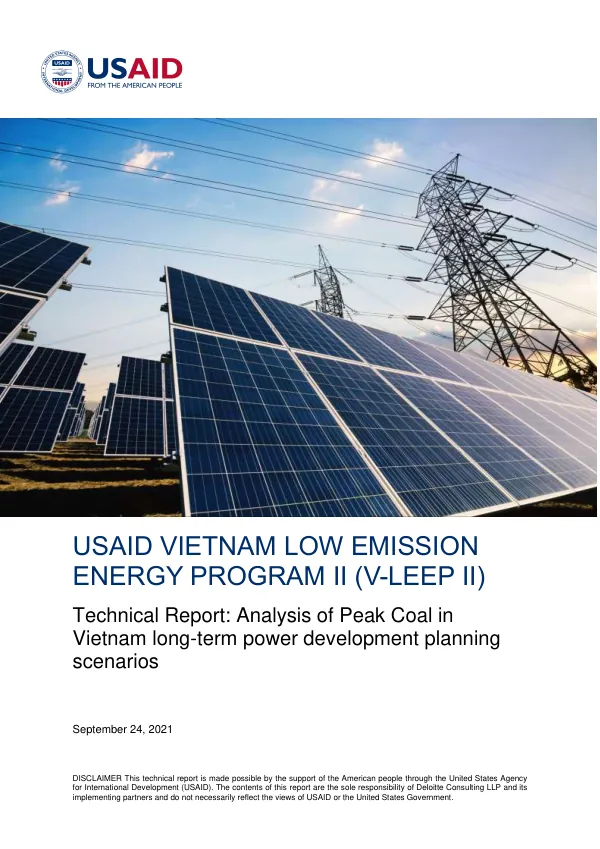
USAID V-LEEP TECHNICAL REPORT: PEAK COAL ANALYSIS FOR VIETNAM LONG-TERM PDP SCENARIOS
Sign inDELOITTE CONSULTING, LLP
USAID V-LEEP TECHNICAL REPORT: PEAK COAL ANALYSIS FOR VIETNAM LONG-TERM PDP SCENARIOS
The concept of "Peak Coal" is defined both in terms of a) the year when the coal consumption is maximum (and declining thereafter); and b) the maximum cumulative coal consumption.
2021 · 49 pages
Sign in to readA free account is required to download.
Abstract
In the context of Vietnam's long-term power development planning scenarios, the analysis focuses on the year when coal consumption reaches its peak and the cumulative coal consumption over time. The study identifies several key scenarios for Vietnam's power sector development, including the Business as Usual (BAU) scenario, the Low Emission Scenario (LES), and the High Emission Scenario (HES). The analysis of these scenarios reveals that the peak coal consumption year varies depending on the scenario, with the BAU scenario reaching its peak in 2025, the LES scenario in 2030, and the HES scenario in 2020. The study also examines the cumulative coal consumption over time, with the BAU scenario showing a steady increase in cumulative coal consumption, the LES scenario showing a gradual decline, and the HES scenario showing a rapid increase. The analysis highlights the importance of considering the cumulative coal consumption when evaluating the long-term implications of different power sector development scenarios. In terms of recommendations, the study suggests that Vietnam's power sector development should prioritize a low-emission scenario to mitigate the risks associated with climate change. The study also recommends that the government consider implementing policies to reduce coal consumption and promote the use of renewable energy sources. The analysis of peak coal consumption and cumulative coal consumption provides valuable insights for policymakers and stakeholders involved in Vietnam's power sector development. By understanding the implications of different scenarios, policymakers can make informed decisions to ensure a sustainable and low-emission power sector. The study's findings are based on a comprehensive analysis of various scenarios, including the BAU, LES, and HES scenarios. The analysis takes into account various factors, including coal consumption, natural gas consumption, and CO2 emissions. The study's recommendations are grounded in the analysis of these scenarios and are intended to support the development of a low-emission power sector in Vietnam. The study's methodology involves the use of a capacity expansion model (CEM) to simulate the power sector development under different scenarios. The CEM model takes into account various factors, including fuel prices, technology costs, and policy interventions. The study's results are presented in various figures and tables, which provide a detailed analysis of the peak coal consumption and cumulative coal consumption under different scenarios. The study's findings have important implications for Vietnam's power sector development. By prioritizing a low-emission scenario, the government can reduce the risks associated with climate change and promote a sustainable power sector. The study's recommendations provide a roadmap for policymakers to achieve this goal, including the implementation of policies to reduce coal consumption and promote the use of renewable energy sources. The study's analysis of peak coal consumption and cumulative coal consumption provides a comprehensive understanding of the long-term implications of different power sector development scenarios. The study's findings are based on a rigorous analysis of various scenarios and are intended to support the development of a low-emission power sector in Vietnam.
Related documents