AMERICAN RED CROSS
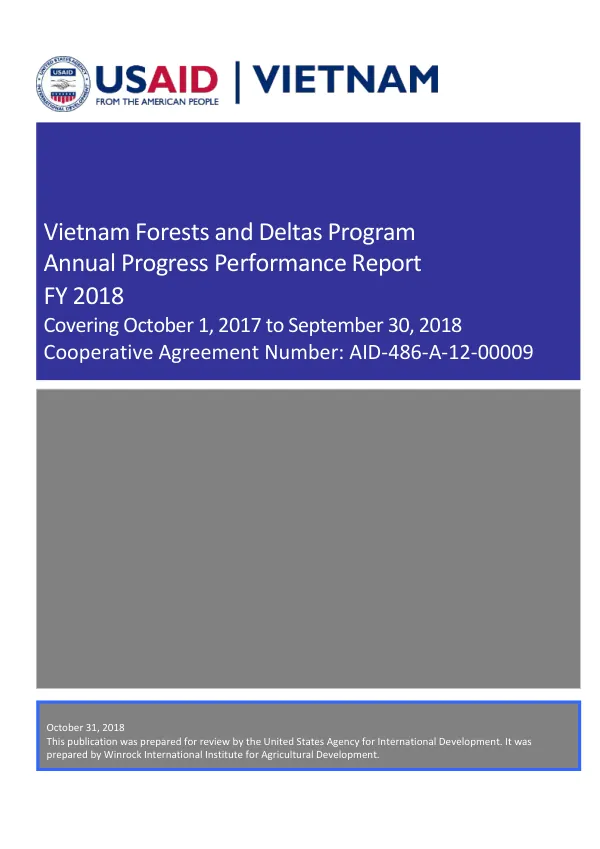
USAID Vietnam Forests and Deltas Program FY2018 Progress Report
The USAID Vietnam Forests and Deltas Program (VFD) was awarded to Winrock International (WI) by the United States Agency for International Development (USAID) as a Cooperative Agreement on September 25, 2012.
2018 · 35 pages
Sign in to readA free account is required to download.
Abstract
The program aimed to accelerate Vietnam's transition to climate-resilient, low-emission, sustainable development by improving forest and natural resource management and engaging communities in the development of action plans to address climate-related vulnerabilities. The program's first phase (2012-2018) was implemented in direct partnership with Vietnam's Ministry of Agriculture and Rural Development (MARD) and through sub-awards with the American Red Cross (ARC), the Center for Sustainable Rural Development (SRD), SNV - Netherlands Development Organization (SNV), and the Vietnam Red Cross (VNRC). The program's work took place through four components: Sustainable Landscapes, Adaptation, National Policy and Coordination, and Cross-Cutting Components. Sustainable Landscapes Component (IR 3) focused on supporting large low-emission development planning efforts in the forestry and agricultural sectors, including Reducing Emissions from Deforestation and Forest Degradation (REDD+), and providing support on ecosystem valuation and natural capital valuation as part of evolving ecosystem payment mechanisms. Adaptation Component (IR 4) ensured that government authorities, local leaders, and communities in delta areas developed an improved understanding of climate-related vulnerabilities and developed action plans to address these vulnerabilities. National Policy and Coordination Component (covering IR 3 and IR 4) aimed to strengthen the capacity of government agencies and local authorities to develop and implement policies and programs that address climate-related vulnerabilities. Cross-Cutting Components included gender, communications, and gender mainstreaming, which aimed to ensure that the program's activities were inclusive and responsive to the needs of all stakeholders. The program's key achievements included: * 27% increase in income among program participants compared to the control group * Improved food security indicators improved across all target communities * Greatest gains in food security gains in communities where both agricultural and market interventions were combined * Women-headed households showed higher adoption rates for all practices except mechanical land preparation * Demonstration plots established in 15 communities showed yield improvements of 60% when applying sustainable practices The program's midterm evaluation revealed a 27% increase in income among program participants compared to the control group. The program's work plan for the next quarter included: * Implementing the Payment for Ecosystem Services (PES) e-payment system * Conducting monitoring and evaluation (M&E) activities * Expanding the PES program to new sectors * Implementing phase 2 start-up activities The program's financial information included a budget breakdown for the year, which showed a total expenditure of $X million. The program's administrative costs were $X million, while the program's implementation costs were $X million. The program's environmental mitigation and monitoring plan was implemented in FY 2018, which aimed to minimize the program's environmental impact and ensure that the program's activities were environmentally sustainable.