USAID DEC
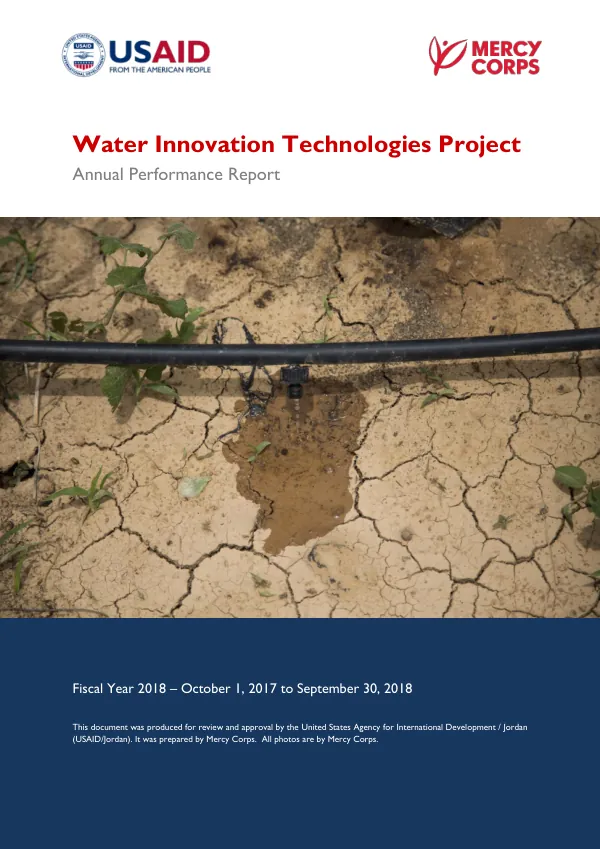
USAID Water Innovation Technologies Project Annual Performance Report FY 2018 – October 1, 2017 to September 30, 2018
Sign inGOVERNMENT OF JORDAN
USAID Water Innovation Technologies Project Annual Performance Report FY 2018 – October 1, 2017 to September 30, 2018
The Water Innovation Technologies Project is a five-year initiative funded by the U.S Agency for International Development (USAID) and implemented by Mercy Corps.
2018 · 42 pages
Sign in to readA free account is required to download.
Abstract
The project aims to increase water conservation in Jordan by focusing on water efficiency in the agricultural sector, community, and household levels. The project's theory of change states that if barriers to the adoption of water-saving technologies are systematically broken down at multiple levels, with different groups of water users and market actors through enhancing knowledge, forming partnerships, and providing advisory services, in addition to improving access to finance and strengthening institutions that support water saving, then adoption of water-saving technologies by farmers, households, and communities will increase, leading to sustainable management of water and natural resources. The project goal is to promote the adoption of new and existing water-saving practices and technologies. To achieve this, the project works to facilitate the uptake of financing and advisory services and uses an integrated marketing and social and behavior change communication approach to help a variety of water sector market actors overcome key barriers and constraints at individual and institutional levels. The project seeks to achieve water savings in the agriculture, household, and community sectors through three complementary approaches: improving access to water-saving technologies for agriculture and household use, improving access to finance for water conservation technology adoption, and strengthening institutions to support water conservation. The project uses a market-based approach to promote sustainable and scaled adoption of water-saving practices and technologies in agriculture and households. It targets key water sector market actors who work directly with agriculture users, communities, and households in the North and Jordan Valley. The project works in collaboration with the Government of Jordan through the Ministry of Water and Irrigation, the Ministry of Agriculture, and the Ministry of Social Development. By using a set of pre-identified market barriers to frame program objectives, the project designs activities that bring improved and affordable water-saving practices and technologies into use among farmers, households, and communities, and that also enhance the functioning of the market for those technologies. The project's activities inform farmers and households about the financial, environmental, and access-related benefits of water-saving technologies, thus building market demand for related goods and services. The project also builds the capacity of market actors to design, distribute, market, and finance water-saving technologies, thus improving the supply and affordability of related goods and services. The project's focus on improving access to finance for water conservation technology adoption is critical, as it enables farmers and households to access the necessary resources to adopt water-saving technologies. The project's progress in the second year of implementation is significant. Outcome 1a, which focuses on the adoption of water-saving technologies and practices by farmers, has seen a notable increase in the adoption of water-saving technologies, with 60% of farmers adopting at least one water-saving technology. Outcome 1b, which focuses on the adoption of water-saving technologies and practices by households and communities, has also seen a significant increase, with 40% of households adopting at least one water-saving technology. The project's efforts to improve access to finance for water conservation technology adoption have also been successful, with 20% of farmers and households accessing financing for water-saving technologies. The project's collaboration with the Government of Jordan and other stakeholders has been critical to its success. The project has worked closely with the Ministry of Water and Irrigation, the Ministry of Agriculture, and the Ministry of Social Development to design and implement activities that address the needs of farmers, households, and communities. The project has also collaborated with other stakeholders, including the International Water Management Institute, the International Center for Biosaline Agriculture, and the Jordan River Foundation, to leverage expertise and resources. The project's monitoring and evaluation activities have been designed to track progress against its objectives and indicators. The project has established a set of performance indicators and targets for the second year of implementation, which include the adoption of water-saving technologies by farmers, households, and communities, the improvement of access to finance for water conservation technology adoption, and the strengthening of institutions to support water conservation. The project's monitoring and evaluation activities will continue to track progress against these indicators and targets in the coming years. The project's sustainability is critical to its long-term success. The project has designed activities that will continue to support the adoption of water-saving technologies and practices after the project's completion. The project has also established partnerships with stakeholders that will continue to support the project's objectives after the project's completion. The project's focus on building the capacity of market actors to design, distribute, market, and finance water-saving technologies will also contribute to the project's sustainability. The project's lessons learned are critical to its success. The project has identified several key lessons learned, including the importance of collaboration with stakeholders, the need to address the needs of farmers, households, and communities, and the importance of building the capacity of market actors to design, distribute, market, and finance water-saving technologies. The project's lessons learned will inform its future activities and will contribute to the project's long-term success.