MERCY CORPS INTERNATIONAL
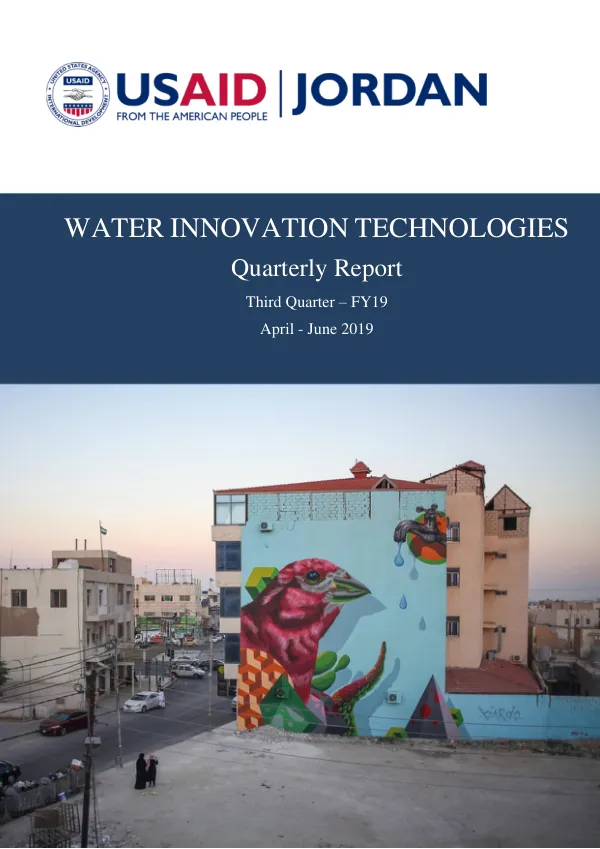
Water Innovation Technologies | Quarterly Report: January-March 2019
The Water Innovation Technologies (WIT) project is a five-year initiative funded by the U.S Agency for International Development (USAID) and implemented by Mercy Corps.
2019 · 46 pages
Sign in to readA free account is required to download.
Abstract
The project aims to increase water conservation in Jordan by focusing on water efficiency in the agricultural sector, community, and household levels. The project's theory of change states that if barriers to the adoption of water saving technologies are systematically broken down at multiple levels, with different groups of water users and market actors through enhancing knowledge, forming partnerships, and providing advisory services, in addition to improving access to finance and strengthening institutions that support water saving, then adoption of water saving technologies by farmers, households, and communities will increase, leading to sustainable management of water and natural resources. The project seeks to achieve three complementary outcomes: improve access to water saving technologies for agriculture and household use, improve access to finance for water conservation technology adoption, and strengthen institutions to support water conservation. WIT uses a market-based approach to promote sustainable and scaled adoption of water saving practices and technologies in agriculture and households. The project targets key water sector market actors who work directly with agriculture users, communities, and households in the North and Jordan Valley. During January-March 2019, the WIT project successfully rolled out a number of activities that followed the Market Systems approach. The project supported and catalyzed the efforts of various market actors and provided improved knowledge, skills, practices, and access to affordable innovative technologies. The project continued to build its progress to save 18.5 million cubic meters of water in agriculture and households in Jordan by March 2022. The project supported agriculture-related initiatives with the installation of 13 demonstration sites, which showcased water-efficient irrigation technologies through field days. The implementations of these field days came as part of different company-led initiatives that encouraged farmers' adoption of water saving technologies. NDICO, one of the Investment Fund sub-grantees, held its first field day with the participation of 50+ attendees. A rapid assessment determined that after this first field day, nine farmers contacted NDICO to purchase water saving technologies, while one additional farmer contacted his own supplier – MAIS Company. The project also encouraged the financial sector by supporting the Jordan Kuwait Bank with the development of their first agriculture financial product. Additionally, the project partnered with Safwa, the Jordan Commercial Bank, and Ethmar to facilitate and provide technical support for one or more formal financing mechanisms and products that support farmers' adoption of water saving technologies. The project sponsored the participation of agricultural suppliers and banks for their participation in the 10th International Sawsana Agricultural Exhibition, which took place in March and targeted 2000+ participants. At the household level, the project launched the Revolving Loan – an initiative that aims to solve the constraints households face to access water saving devices and technologies. The project identified the key constraints that prevent communities from adopting WSD/T and developed micro, small, medium, and large loans that will be offered to households through CBOs. The project also supported suppliers by developing discounted water saving devices packages to encourage the adoption of these technologies.