CHEMONICS
Innovative Conservation Models for Páramos and Forests Task Order Work Plan
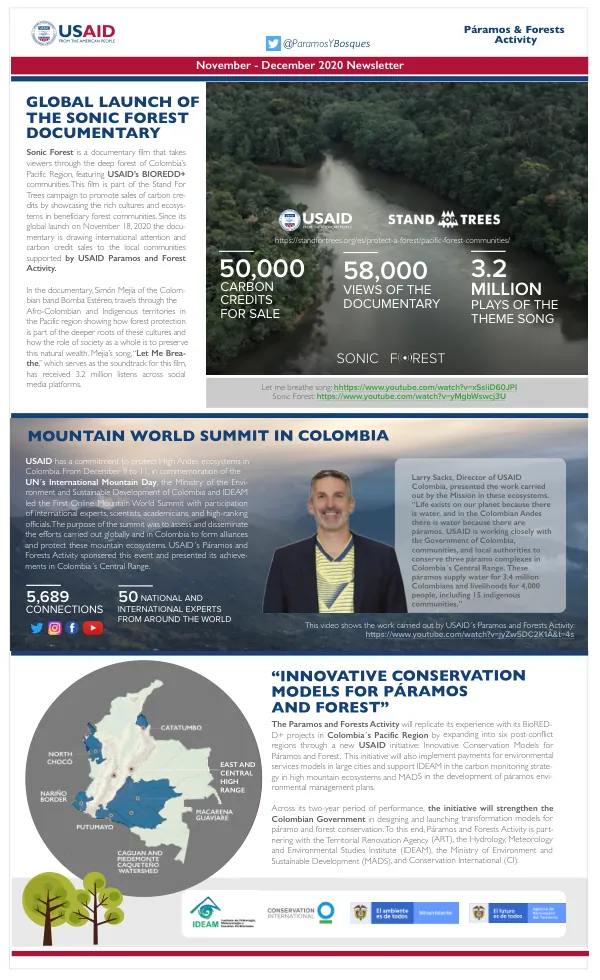
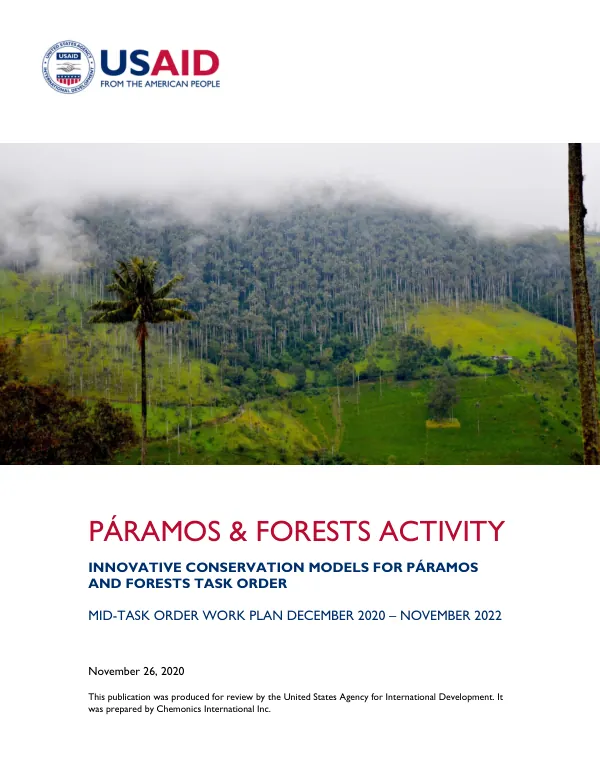
The Páramos & Forests Activity Innovative Conservation Models for Páramos and Forests Task Order outlines a complex set of activities to be implemented over a two-year period.
2020 · 58 pages
Sign in to readA free account is required to download.
Abstract
The task order team, in collaboration with the Páramos & Forests team, aims to achieve three objectives. Objective 1 focuses on building capacity of Territorial Renovation Agency (ART)-selected Territorially Focused Development Programs (PDET) communities and stakeholders to evaluate and promote private sector-led Reduced Emissions from Deforestation and forest Degradation (REDD+) projects. This objective involves providing support to build capacity, including training and technical assistance, to enable communities and stakeholders to effectively evaluate and promote REDD+ projects. Objective 2 involves structuring and implementing a pilot project that links the new water tariff for environmental investments established in CRA's resolution 907 of 2020 with other economic instruments and financial incentives for the protection of watersheds and water sources in a municipality of the Guacheneque-Guerrero-Chingaza-Sumapaz (CCPGGChS) Páramos. The pilot project aims to demonstrate the effectiveness of this approach and facilitate national replication. Objective 3 provides institutional support for improved Monitoring, Reporting, and Verification (MRV) in Colombia's high-Andean ecosystems and for the elaboration of a reconversion strategy in páramos. This objective involves working with the Ministry of Environment and Sustainable Development (MADS) and the Hydrology, Meteorology, and Environmental Studies Institute (IDEAM) to improve MRV systems and develop a reconversion strategy for páramos. The main purpose of the task order is to allow the United States Agency for International Development (USAID) to apply lessons learned from Páramos & Forests and BioREDD+ and the experiences of Conservation International (CI) and other organizations to expand innovative conservation and greenhouse gas (GHG) mitigation models. The task order will support Government of Colombia (GOC) policies, strategies, and nationally determined contribution (NDC) commitments under the Paris Accord. The overall strategy guiding the development of the workplan leverages the experience of Páramos & Forests and main partners, garners institutional commitment to expand capacity, creates favorable enabling regulatory frameworks, and increases investment for replicability. The strategy also emphasizes flexibility and adaptive management, especially in light of COVID-19, evolving security conditions, and new leadership in MADS. The task order team will foster close and continuous coordination and collaboration with USAID, GOC agencies, communities, civil society organizations, and the private sector. Coordination mechanisms include regular meetings, joint planning, and information sharing to ensure effective implementation of the task order activities. The task order will support the development of a comprehensive workplan, which will outline specific activities, timelines, and milestones for each objective. The workplan will be developed in close collaboration with the Páramos & Forests team and will be regularly reviewed and updated to ensure that the task order activities are aligned with the overall strategy and objectives. The task order team will also establish a communication and outreach plan to ensure that stakeholders are informed about the task order activities and progress. The plan will include targeted communication and outreach to US and Colombian government influencers, private sector actors, media and opinion leaders, local authorities, leaders and communities, and the broader development community. The task order will be implemented over a two-year period, from December 2020 to November 2022. The implementation will be guided by a detailed workplan, which will outline specific activities, timelines, and milestones for each objective. The task order team will work closely with the Páramos & Forests team, USAID, GOC agencies, communities, civil society organizations, and the private sector to ensure effective implementation of the task order activities.
Related documents