USAID DEC
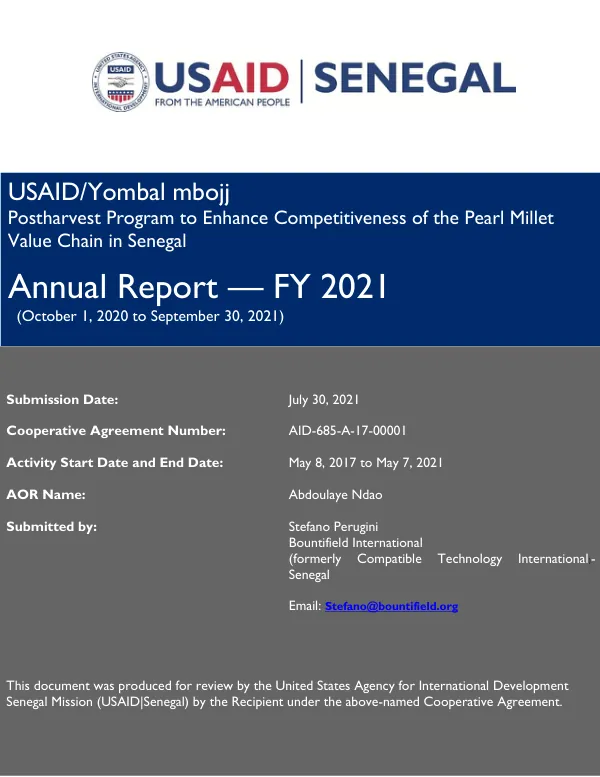
USAID/Yombal mbojj Postharvest Program to Enhance Competitiveness of the Pearl Millet Value Chain in Senegal Annual Report — FY 2021
Sign inUSAID
USAID/Yombal mbojj Postharvest Program to Enhance Competitiveness of the Pearl Millet Value Chain in Senegal Annual Report — FY 2021
The Yombal mbojj Postharvest Program to Enhance Competitiveness of the Pearl Millet Value Chain in Senegal aimed to increase the availability of high-quality grains on the local market by addressing the gap in technologies available for smallholder pearl millet producers, particularly women.
2021 · 29 pages
Sign in to readA free account is required to download.
Abstract
The project worked to introduce affordable post-harvest processing tools, improve distribution strategies, and link farmers to markets for quality millet, thereby strengthening technology adoption and increasing incomes of smallholders. The project prioritized strengthening private sector capacities to develop and distribute affordable tools addressing the unique needs of women smallholders, who contribute the majority of the labor involved in millet production, particularly post-harvest handling and processing. Using a facilitation approach, the project joined forces with partners to develop a "business in a box model" for smallholder farmers to make profit from their harvest. In the final year of implementation, Bountifield focused on supporting farmers who have the Generation 4 threshers to ensure they were able to use them during the threshing season and beyond. The project worked with Omega Technology to support repair and maintenance of the threshers and with already identified and trained artisans to offer a training curriculum that strengthens their ability to support farmers who need repair and maintenance support for their threshers. Thresher utilization and repairs were a key focus area for the project. Five villages, mostly in Kaffrine, had individuals who reported using the thresher to process their millet. A total of 2,275 kilograms of millet were threshed, representing an average of 175 kilograms per person. The farmers used the thresher for household consumption as none reported intending it for sale. The project also worked with OMEGA's lead engineer, director, and mechanical technician to design and repair emerging issues on the thresher. Bountifield and OMEGA developed technical, repair, and maintenance solutions, and OMEGA worked with the six trained artisans to develop and implement the repair and maintenance plan in 25 different areas. A three-day training session was organized in Kaolack to discuss and conceptualize the repair and maintenance plan. The project's goal was to build economically sustainable millet postharvest processing equipment supply and millet value chains in Senegal that generate revenues and create assets for smallholder farmers, especially women. The main objectives were to develop local capacity for manufacturing and distribution of improved postharvest millet technologies tailored to smallholder farmers, especially women; create a financial, business, and technical training package to support profitable enterprise development among smallholders with postharvest technologies; and build awareness among smallholder farmers, especially women, of postharvest technologies and the associated market opportunities for high-quality grain and value-added products. The project's activities and results in FY21 were focused on supporting farmers who have the Generation 4 threshers and working with agrodealers to promote and market the multi-crop grinder and its business in a box model. The project also continued to work with already identified and trained artisans to offer a training curriculum that strengthens their ability to support farmers who need repair and maintenance support for their threshers. Overall, the Yombal mbojj Postharvest Program to Enhance Competitiveness of the Pearl Millet Value Chain in Senegal made significant progress in its final year of implementation, focusing on supporting farmers who have the Generation 4 threshers and working with agrodealers to promote and market the multi-crop grinder and its business in a box model. The project's activities and results demonstrate its commitment to building economically sustainable millet postharvest processing equipment supply and millet value chains in Senegal that generate revenues and create assets for smallholder farmers, especially women.