USAID
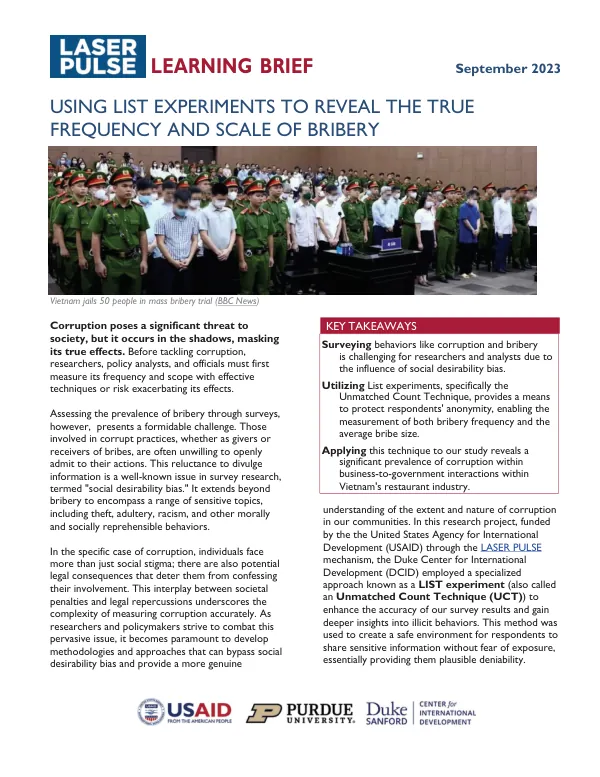
Using List Experiments to Reveal the True Frequency and Scale of Bribery
In Vietnam, corruption poses a significant threat to society, but it occurs in the shadows, masking its true effects.
2023 · 4 pages
Sign in to readA free account is required to download.
Abstract
Assessing the prevalence of bribery through surveys presents a formidable challenge due to social desirability bias. Individuals involved in corrupt practices are often unwilling to openly admit to their actions, fearing social stigma and potential legal consequences. To measure the frequency and scale of bribery, researchers employed a specialized approach known as a LIST experiment, also called the Unmatched Count Technique (UCT). This method creates a safe environment for respondents to share sensitive information without fear of exposure, providing plausible deniability. A sample list question from the survey presented individuals with one of two distinct question sets, denoted as Version A and Version B. Each set initiated with three routine, non-sensitive activities associated with inspections, but Version A introduced a sensitive query concerning the act of offering gifts to government inspectors, a behavior often regarded as a bribe. By analyzing all the responses collectively, researchers could estimate the prevalence of the sensitive behavior without compromising anyone's confidentiality. In this project, it was hypothesized that restaurants in the Management and Internal Controls courses would have greater regulatory compliance and therefore would be less vulnerable to bribes than those in the Marketing course. In line with theoretical expectations, it was discovered that restaurants participating in the Management and Internal Controls courses reported paying bribes less often, and these bribes were smaller compared to those in the Marketing course. To determine the amount of bribe payments, the same method used in previous analyses was applied to the cost associated with each activity related to inspections that a firm might have been involved in. The results closely mirrored earlier findings. For businesses that participated in the Management and Internal Controls courses, the costs of bribery during inspections were remarkably low, with respondents reporting paying $3 USD and $4.20 USD, respectively, for inspection bribes in the past month. In contrast, students from the marketing placebo course paid significantly higher inspection bribes, averaging $34 USD last month. The LIST experiment, also known as the Unmatched Count Technique (UCT), holds significant promise for its application in policy analysis and research. This innovative approach offers unique advantages in capturing sensitive behaviors that are often concealed due to social desirability bias. As demonstrated in the research project, list experiments allowed researchers to uncover striking differences in the frequency and size of bribes in various groups. The results of this study highlight the importance of using effective techniques to measure the frequency and scope of bribery, and the potential of the LIST experiment to provide a more accurate understanding of the extent and nature of corruption in communities.
Related documents
Documents in this collection
 2021
2021USAID DEC
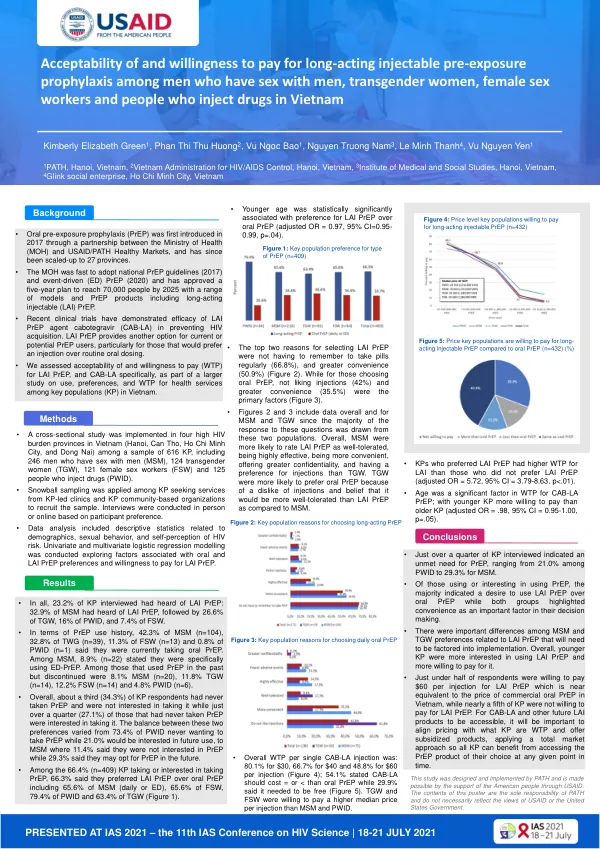
Acceptability of and willingness to pay for long-acting injectable pre-exposure prophylaxis among men who have sex with men, transgender women, female sex workers and people who inject drugs in Vietnam
Open record 2021
2021USAID DEC