U.S. NATIONAL RENEWABLE ENERGY LABORATORY
Utility-Scale Wind and Solar in Emerging Markets—Private Sector Perspectives
Global energy investment reached nearly two trillion U.S.
2019 · 4 pages
Sign in to readA free account is required to download.
Abstract
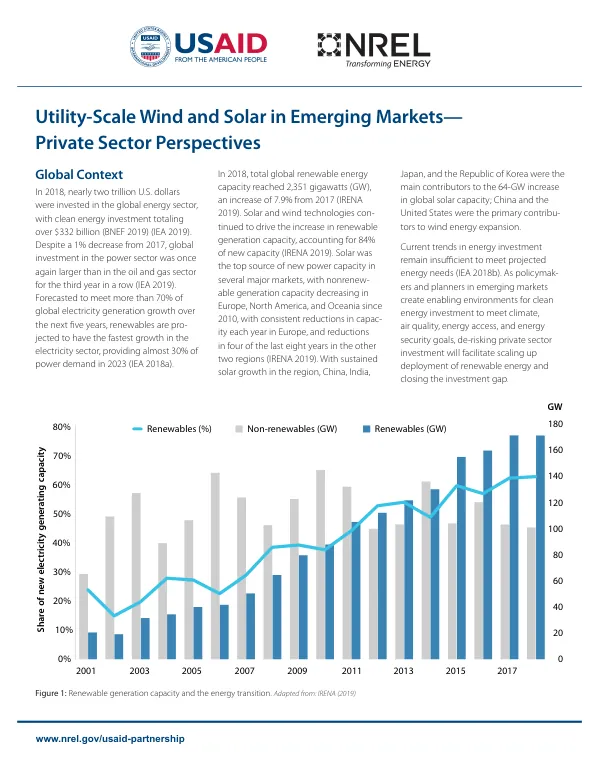
dollars in 2018, with clean energy investment totaling over $332 billion. Despite a 1% decrease from 2017, global investment in the power sector was larger than in the oil and gas sector for the third year in a row. Renewables are forecasted to meet more than 70% of global electricity generation growth over the next five years, providing almost 30% of power demand in 2023. In 2018, total global renewable energy capacity reached 2,351 gigawatts, an increase of 7.9% from 2017. Solar and wind technologies continued to drive the increase in renewable generation capacity, accounting for 84% of new capacity. Solar was the top source of new power capacity in several major markets, with non-renewable generation capacity decreasing in Europe, North America, and Oceania since 2010. China, India, Japan, and the Republic of Korea were the main contributors to the 64-GW increase in global solar capacity, while China and the United States were the primary contributors to wind energy expansion. Current trends in energy investment remain insufficient to meet projected energy needs. As policymakers and planners in emerging markets create enabling environments for clean energy investment, de-risking private sector investment will facilitate scaling up deployment of renewable energy and closing the investment gap. Renewable energy market potential is high, but private sector players face several barriers and uncertainties in nascent markets. Private sector representatives ranked various barriers to market entry in emerging markets, highlighting political instability, access to finance, lack of local technical expertise, and lack of renewable energy policies and incentives as their top barriers. Access to finance is a significant challenge, especially early-stage capital and finance. Initial development costs can be a significant barrier, and supporting project pipeline development can help alleviate barriers and assist in facilitating renewable energy deployment in emerging markets. Lack of local technical expertise is another notable barrier to private sector investment in emerging markets. Educating and providing technical assistance to decision makers and the local labor force on best practices could help build capacity and provide an opportunity to advance a deeper understanding of enabling operational strategies for advancing utility-scale renewable energy deployment. Establishing systems that encourage cost-effective pricing, taking into consideration quality and probability of execution, can also support informed planning and investment in the clean energy sector.