USAID DEC
Scaling Up Renewable Energy Generation: Aligning Targets and Incentives with Grid Integration Considerations
Sign inDEPARTMENT OF AGRICULTURE
Scaling Up Renewable Energy Generation: Aligning Targets and Incentives with Grid Integration Considerations
California's renewable energy targets and grid integration studies have been instrumental in supporting progressively higher penetrations of wind and solar energy.
2015 · 2 pages
Sign in to readA free account is required to download.
Abstract
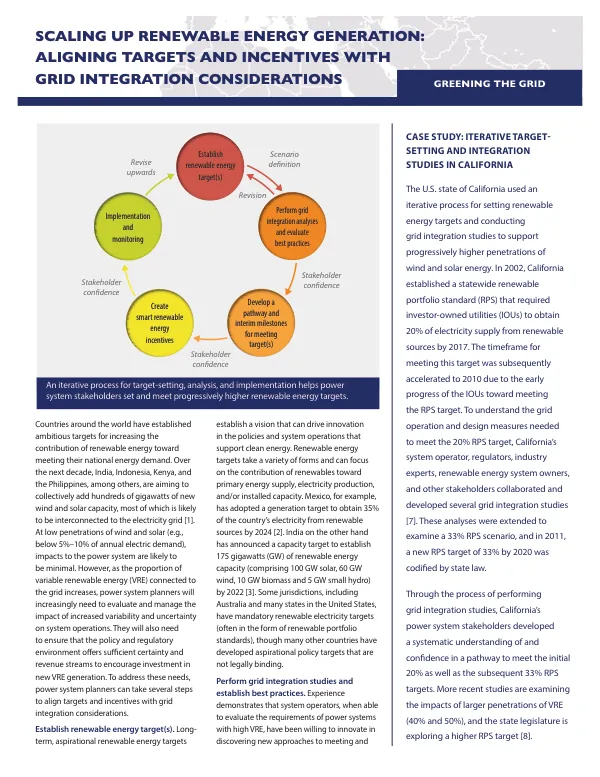
In 2002, the state established a statewide renewable portfolio standard (RPS) requiring investor-owned utilities to obtain 20% of electricity supply from renewable sources by 2017. The timeframe for meeting this target was subsequently accelerated to 2010 due to the early progress of the utilities toward meeting the RPS target. To understand the grid operation and design measures needed to meet the 20% RPS target, California's system operator, regulators, industry experts, renewable energy system owners, and other stakeholders collaborated and developed several grid integration studies. These analyses were extended to examine a 33% RPS scenario, and in 2011, a new RPS target of 33% by 2020 was codified by state law. Through the process of performing grid integration studies, California's power system stakeholders developed a systematic understanding of and confidence in a pathway to meet the initial 20% as well as the subsequent 33% RPS targets. Countries around the world have established ambitious targets for increasing the contribution of renewable energy toward meeting their national energy demand. Over the next decade, India, Indonesia, Kenya, and the Philippines, among others, are aiming to collectively add hundreds of gigawatts of new wind and solar capacity, most of which is likely to be interconnected to the electricity grid. At low penetrations of wind and solar (e.g., below 5-10% of annual electric demand), impacts to the power system are likely to be minimal. However, as the proportion of variable renewable energy (VRE) connected to the grid increases, power system planners will increasingly need to evaluate and manage the impact of increased variability and uncertainty on system operations. Establishing renewable energy targets is a crucial step in driving innovation in policies and system operations that support clean energy. Targets take a variety of forms and can focus on the contribution of renewables toward primary energy supply, electricity production, and/or installed capacity. For example, Mexico has adopted a generation target to obtain 35% of the country's electricity from renewable sources by 2024, while India has announced a capacity target to establish 175 gigawatts (GW) of renewable energy capacity by 2022. Grid integration studies are essential in informing stakeholders on the ability and needs of a power system to accommodate significant VRE. These studies both inform and are informed by targets for renewable energy generation, and iteration between target setting and studies of operational feasibility builds confidence among power system stakeholders and investors in the ability of a power system to meet a target. Grid integration studies can identify specific needs (and associated costs) that must be addressed for a power system to meet its renewable energy targets, and planners can use insights from these studies to define a system-specific pathway for achieving their targets. Creating smart renewable energy incentives is also critical in encouraging VRE deployment. Power system planners can draw upon a variety of near-term "grid-aware" policies and incentives that encourage VRE generators to provide grid-support services. Grid-aware incentives include incentives for grid support capabilities, incentives and planning processes to address congestion, incentives for aligning generation with demand, incentives for the provision of forecasting data, incentives for integration with dispatch optimization, and incentives for dispatchable renewable resources. Policymakers can also combine incentives to encourage investment in new VRE generation, such as coupling price support mechanisms with requirements that generators implement technologies that contribute to grid stability. Implementation and monitoring are critical to understanding successes and roadblocks throughout the implementation of policies, incentives, and actions to encourage higher utilization of VRE. Capturing these insights and systematically tracking progress toward meeting interim milestones and targets will help planners identify and scale up interventions that are particularly effective within a given system. This iterative process also informs the revision of pathways and targets over time.