RTI INTERNATIONAL
UWA Wildlife Protection Law Campaign Report
The USAID Wildlife Asia Activity aimed to end transnational wildlife crime in Asia by employing a comprehensive approach through improved regional cooperation.
2021 · 24 pages
Sign in to readA free account is required to download.
Abstract
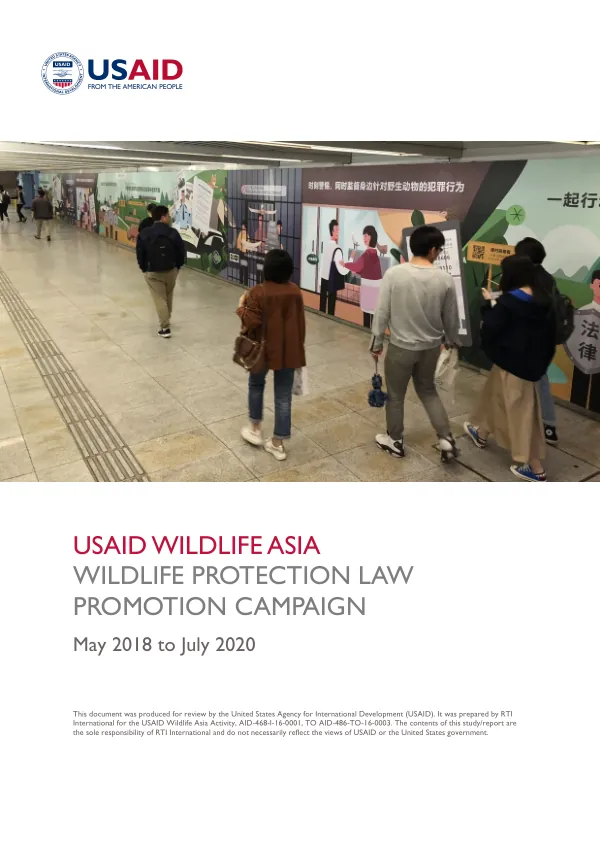
The global value of illegal wildlife crime is estimated at $20 billion annually. Organized wildlife crime destroys wildlife populations and wildlife-based livelihoods, creating social and political instability. The Activity's desired outcomes included reduction in consumer demand for wildlife parts and products; improved enforcement of existing laws, policies, and agreements related to wildlife crime; passing and implementation of new laws, policies, or reforms; improved cooperation and collaboration among regional, international, and inter-institutional law enforcement; and increased collaboration and coordination between development partners and U.S. Government agencies involved in combating wildlife trafficking (CWT). For consumer demand reduction activities, USAID Wildlife Asia focus countries were China, Thailand, and Vietnam. In China, the project focused on reduction of demand for parts and products from four focal species – elephant ivory, pangolin, rhino, and tiger. In Thailand, the focus was on reducing demand for elephant ivory and tiger products. In Vietnam, the focus was on rhino horn. The project applied a social and behavior change communication (SBCC) framework to plan, implement, and evaluate demand reduction campaigns. The SBCC framework uses a consumer research-based planning process and a socio-ecological model of change to identify the tipping points for behavior change. It operates through three strategies – advocacy, social mobilization, and behavior change communication – to achieve its behavior change objectives. This report documents the Wildlife Protection Law (WPL) campaign to reduce consumer demand for elephant ivory, pangolin, rhino, and tiger products implemented from May 2018 to July 2020 in China. The campaign aimed to reduce consumer demand by targeting the root causes of demand, including awareness, attitudes, and behaviors. The project's SBCC campaigns were informed by a simplified model of the USAID Wildlife Asia Demand Reduction Theory of Change. The theory of change reflects the interplay between attitudes (comprised of perceived benefits and perceived concerns about wildlife products) and social norms (perceptions related to the social acceptability of using wildlife products) that contribute to driving intention to buy or use wildlife parts and products. This intention then leads to actual purchase and use behaviors. If attitudes that discourage use of wildlife products are improved (reduce benefits and/or increase concerns) and social acceptability about wildlife product use is decreased, the interplay of these factors will lead to decreased intention to buy or use wildlife products, and eventually lead to decreased purchase and use of wildlife products. The campaign's objectives were to increase desired attitudes related to consumption of parts and products of targeted wildlife species, increase the perception that consuming and buying wildlife products is not socially acceptable, decrease the intention to purchase wildlife products in the future, and decrease self-reported wildlife product purchases among target audiences. The campaign implemented a range of activities, including materials development, pretesting, and production, dissemination strategy, launch, dissemination and reach, out-of-home media, public and private sector dissemination support, and results and leveraged funds. The campaign's geographic focus was China, with a specific focus on reducing demand for parts and products from four focal species – elephant ivory, pangolin, rhino, and tiger. The campaign's implementation involved a range of activities, including the development and dissemination of campaign materials, the launch of the campaign, and the dissemination and reach of the campaign through various channels. The campaign's results and leveraged funds are also discussed in this report. The campaign's impact was evaluated through a 2021 China Monitoring Survey, which found that the campaign had achieved its objectives. The survey found that there was a 25% increase among target audiences exposed to the campaign with desired attitudes related to consumption of parts and products of targeted wildlife species. The survey also found that there was a 30% increase in target audiences saying that consuming and buying wildlife products is not socially acceptable, a 25% decrease in target audiences reporting that they would like to purchase wildlife products in the future, and a 10% decrease in self-reported wildlife product purchases among target audiences. The campaign's results demonstrate the effectiveness of the SBCC approach in reducing consumer demand for wildlife parts and products. The campaign's impact was achieved through a range of activities, including the development and dissemination of campaign materials, the launch of the campaign, and the dissemination and reach of the campaign through various channels. The campaign's results also highlight the importance of targeting the root causes of demand, including awareness, attitudes, and behaviors, in reducing consumer demand for wildlife parts and products.