TETRA TECH ESI, INC.
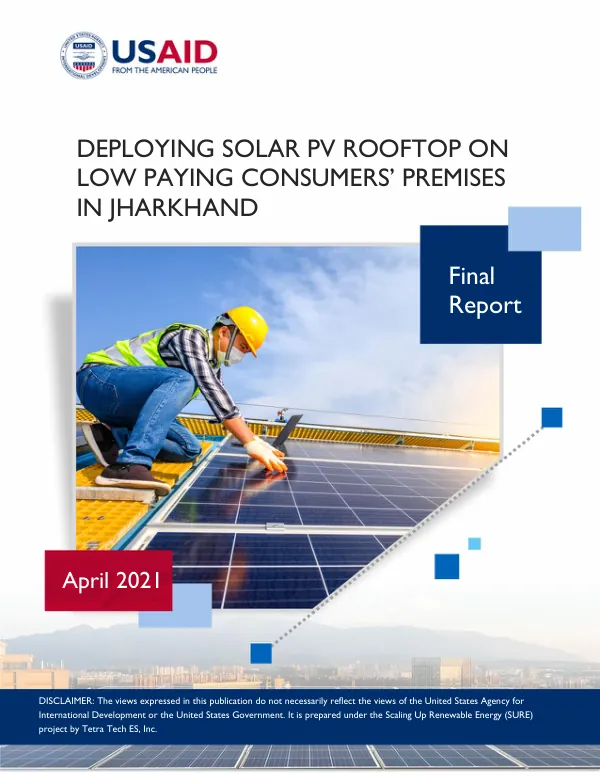
Report on Deploying Solar PV Rooftop on Low Paying Consumers Premises in Jharkhand
JBVNL, the distribution company in Jharkhand, undercharges several consumer categories, with Domestic being the largest in terms of electricity consumption.
2021 · 162 pages
Sign in to readA free account is required to download.
Abstract
The difference between the tariff and cost of supply for these low-paying consumers (LPC) is funded through cross subsidy and state government subsidy. One of the major components of the cost of supply is transmission and distribution losses (T&D). Out of the projected cost of supply of INR 6.39/kWh for these consumers, INR 1.09/kWh can be attributed to T&D loss. Cost increases with an increase in T&D loss. By reducing the T&D loss, JBVNL can reduce cost of supply and subsequently the gap between the consumer tariff and cost of supply for LPC. Solar PV Rooftop (SPVRT) due to the co-location of generation with consumption, can reduce T&D losses and thus the cost of supply. JBVNL gains the highest when SPVRT is deployed at the tail-ends of the grid where LPC are typically located and where the losses are higher. These consumers do not have any incentive to deploy SPVRT due to the low tariffs they pay and lack of wherewithal, including availability of finance, to deploy SPVRT. Defragmented nature of market and lack of or limited availability of certified installers and lack of public information about the approval process are also major challenges. COVID-19 has further impacted SPVRT deployment. JBVNL has floated a tender for SPVRT deployment in the last quarter of 2020-21. The tender documents have been finalized, and the timelines are as follows: the tender will be floated for bidding, and the selected bidder will be awarded the contract. The project will be implemented under the Super RESCO model, where the RESCO will be responsible for designing, installing, and maintaining the SPVRT system. The Super RESCO model has been implemented in several states in India, including Andhra Pradesh, Gujarat, and Kerala. The model has been successful in reducing the cost of SPVRT deployment and increasing the adoption rate among consumers. The key stakeholders involved in the pilot project are JBVNL, the RESCO, and the consumers. The responsibilities of the key stakeholders in the pilot project are as follows: JBVNL will provide the necessary infrastructure and support to the RESCO, while the RESCO will design, install, and maintain the SPVRT system. The consumers will be responsible for paying the electricity bills and maintaining the SPVRT system. The assumptions and savings from the 25 MW SPVRT project are as follows: the project will reduce the T&D loss by 10%, resulting in a savings of INR 1.09/kWh. The total savings will be INR 27.25 lakhs per annum. The project will also reduce the cost of supply by INR 0.54/kWh, resulting in a savings of INR 13.5 lakhs per annum. The key lessons from other states are as follows: the Super RESCO model has been successful in reducing the cost of SPVRT deployment and increasing the adoption rate among consumers. The model has also helped in reducing the T&D loss and increasing the revenue of the distribution companies. The key stakeholders involved in the pilot project are the distribution company, the RESCO, and the consumers.