USAID DEC
Vermicompost – Care and Maintenance for your worm bin
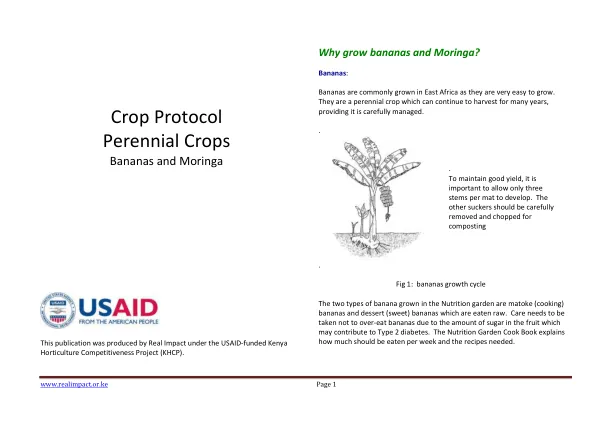
The Kenya Horticulture Competitiveness Project (KHCP) has produced a publication on perennial crops, specifically bananas and Moringa, under the guidance of Real Impact.
2012 · 11 pages
Sign in to readA free account is required to download.
Abstract
The publication aims to provide information on the cultivation, harvesting, and utilization of these crops. Bananas are a perennial crop commonly grown in East Africa due to their ease of cultivation. To maintain good yield, it is essential to allow only three stems per mat to develop, with the other suckers carefully removed and chopped for composting. The two types of bananas grown in the Nutrition garden are matoke (cooking) bananas and dessert (sweet) bananas, which are eaten raw. However, care needs to be taken not to over-eat bananas due to the high sugar content, which may contribute to Type 2 diabetes. Moringa, on the other hand, is a Nutrition Super-Food that provides high levels of protein, vitamin A, vitamin C, iron, calcium, and selenium. The recommended daily intake of Moringa leaf powder is 10 grams, which can be obtained from 100 grams of fresh leaves. Moringa is a drought-tolerant crop that can be grown as a tree in semi-arid lands, making it an ideal crop for areas with limited water resources. The publication provides guidelines for planting and growing Moringa, including the ideal temperature range (25-35°C), altitude (below 600m), and soil type (well-drained sandy-loam or loam with a pH of 5.0-9.0). Moringa can be propagated by seeds or cuttings and can be grown as a tree or as a "perennial-vegetable" under intensive cultivation. Regular pruning or trimming is recommended to encourage branching and leaf production. The publication also provides information on harvesting and processing Moringa leaves, including drying, grinding, and storing Moringa leaf powder. The powder can be stored for up to a year under specific conditions and can be added to any food or beverage to increase the vitamin, mineral, and protein content. Moringa Leaf Powder has the greatest impact on vulnerable individuals, including malnourished children, pregnant or lactating women, children at weaning age, HIV/AIDS patients, and the elderly. In addition to its nutritional benefits, Moringa can also be used for water purification. Dirty water can be purified by crushing Moringa seeds and adding them to the water. Moringa is also grown for its edible nutritious pods, which can only be harvested from mature trees, not from coppices. The publication concludes by highlighting the potential of bananas and Moringa as perennial crops for improving food security and nutrition in Kenya. With proper cultivation and harvesting practices, these crops can provide a sustainable source of income and nutrition for farmers and communities.