USAID DEC
Kenya Country Survey Report on FTF Zone of Influence Population Based Survey
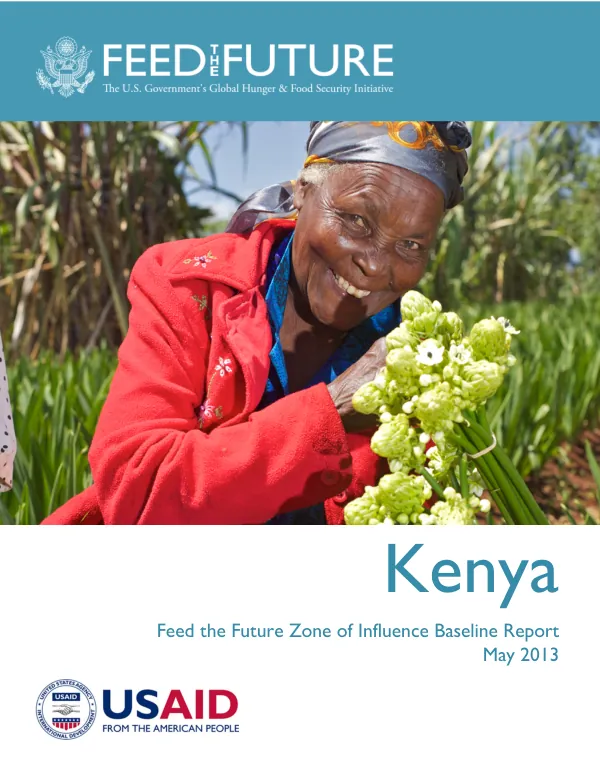
The Feed the Future Zone of Influence Baseline Report for Kenya was conducted in May 2013 to provide a comprehensive understanding of the current status of indicators of interest and establish a benchmark for performance monitoring and future impact evaluation of the strategy.
2013 · 49 pages
Sign in to readA free account is required to download.
Abstract
The report focuses on the high rainfall area 1 (HR1) and semi-arid area 2 (SA2), covering 22 counties in Kenya. The report highlights that the majority (73%) of primary respondents were female, with an average age of 44 years. Approximately 50 percent of primary respondents had a primary 4-8 level of education, while a higher percentage (41%) had less than primary education in female adult only households. The mean number of total and female household members was 5.5 and 2.7, respectively, with a higher number of older children (5-17 years) compared to younger children (0-5 years). The report also presents data on dwelling characteristics, water, and sanitation. On average, surveyed households owned their main houses and had an average of three rooms. The majority (88%) of households had houses roofed with corrugated iron sheets, while over 60 percent had earth/mud walls and 70 percent had floors of earth/mud. The proportions of households with electricity, improved water source, and sanitation facilities were 13.9, 54.5, and 14.5 percent, respectively. Firewood was the most commonly used cooking fuel, reported by nearly 92 percent of households. The report also examines consumption expenditure and poverty. The mean per capita expenditure per day was USD 2, with significant differences among household types. Food items occupied the largest share (over 55%) in household expenditure, irrespective of household type. Using a poverty line of $1.25 per person per day, 44.7 percent of individuals in the survey were poor, with the proportion differing significantly across household types. The report also presents data on nutrition and household hunger. Approximately 49 percent of children less than six months were exclusively breastfed, while 27 percent of children 6-23 months of age received minimum acceptable diet. Prevalence of minimum acceptable diet was more favorable among female adult only households compared to male and female adult households. About 74 and 30 percent of children 6-23 months received minimum feeding frequency and minimum dietary diversity, respectively. The Women's Empowerment in Agriculture Index (WEAI) was also calculated, with a mean score of 0.35 out of 1. The WEAI score indicates that women in the survey have limited empowerment in agriculture, with significant differences among household types. The report highlights the need for interventions to improve women's empowerment in agriculture and reduce poverty and hunger in the region. The report concludes that the baseline survey provides a comprehensive understanding of the current status of indicators of interest and establishes a benchmark for performance monitoring and future impact evaluation of the strategy. The findings highlight the need for interventions to improve women's empowerment in agriculture, reduce poverty and hunger, and improve nutrition and household hunger.
Related documents