INTERNATIONAL INSTITUTE OF TROPICAL AGRICULTURE
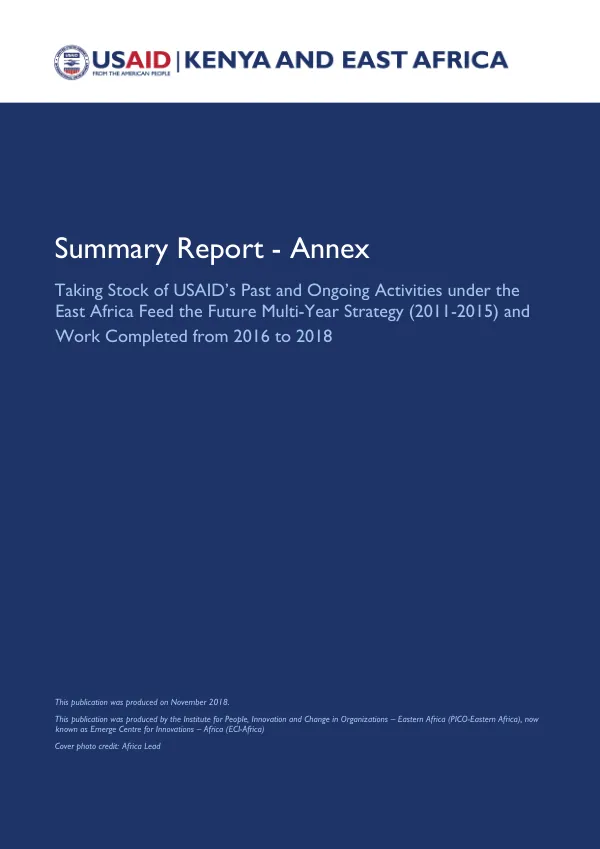
USAID East Africa Feed the Future Stock-Take Report
The East Africa Feed the Future Multi-Year Strategy (2011-2015) was a comprehensive development program implemented by the United States Agency for International Development (USAID) in collaboration with regional stakeholders.
2018 · 62 pages
Sign in to readA free account is required to download.
Abstract
The program aimed to improve agricultural productivity, enhance food security, and promote economic growth in East Africa. The strategy was implemented in six countries: Burundi, Democratic Republic of Congo, Kenya, Rwanda, Tanzania, and Uganda. The program focused on three main areas: resilience, nutrition, and technology development and deployment. Resilience interventions aimed to improve agricultural productivity and enhance farmers' ability to adapt to climate change. Nutrition interventions focused on improving access to nutritious food, particularly for vulnerable populations such as women and children. Technology development and deployment interventions aimed to enhance the use of information and communication technologies (ICTs) in agriculture. The program achieved significant results in all three areas. In resilience, the program supported the development of climate-resilient agricultural practices, which led to improved crop yields and increased farmers' income. In nutrition, the program improved access to nutritious food, particularly for women and children, through the development of nutrition-sensitive agriculture practices. In technology development and deployment, the program enhanced the use of ICTs in agriculture, which improved farmers' access to market information and increased their productivity. The program also identified several cross-cutting issues that underpinned programming, including the need for improved coordination among regional stakeholders, enhanced capacity building for farmers and extension agents, and increased investment in agricultural research and development. The program also highlighted the importance of addressing the root causes of poverty and hunger, including inequality and lack of access to markets and resources. The USAID East Africa Feed the Future program worked with several key implementing partners, including the Common Market for Eastern and Southern Africa (COMESA), the East African Community (EAC), the Intergovernmental Authority on Development (IGAD), and the Agricultural Cooperative Development International/Volunteers in Overseas Cooperative Assistance (ACDI/VOCA). These partners played a critical role in implementing the program's activities and achieving its objectives. Overall, the East Africa Feed the Future Multi-Year Strategy (2011-2015) was a successful program that achieved significant results in improving agricultural productivity, enhancing food security, and promoting economic growth in East Africa. The program's achievements and lessons learned provide valuable insights for future development initiatives in the region.
Related documents