INSTITUTE OF POPULATION, HEALTH, AND DEVELOPMENT
Vietnam Local Works for Environmental Health Study
Vietnam's Local Works for Environmental Health activity, implemented by the Institute of Population, Health, and Development (PHAD), aimed to engage partners in making water works more locally owned and sustainable.
2021 · 2 pages
Sign in to readA free account is required to download.
Abstract
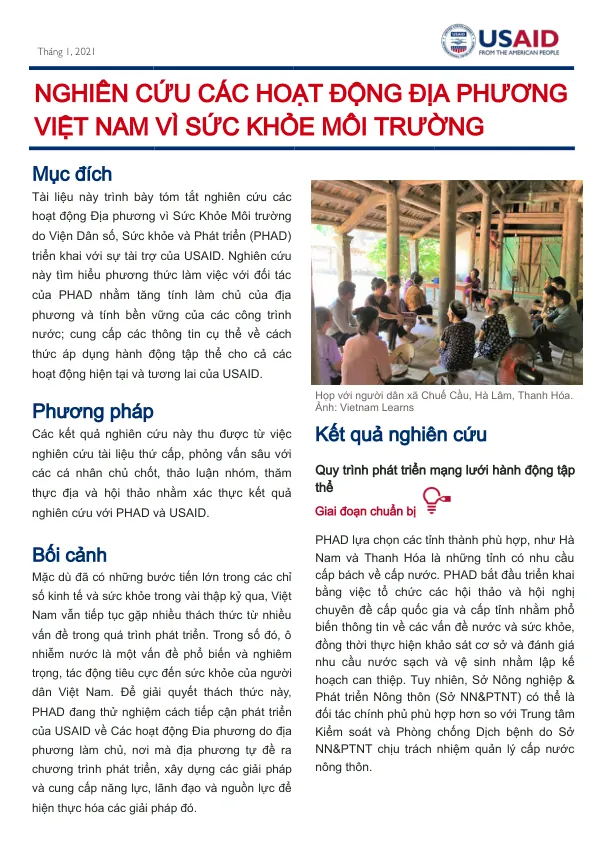
This study explored PHAD's process of collective action and its potential adaptation for current and new USAID activities. PHAD selected provinces with urgent water supply needs, including Ha Nam and Thanh Hoa, and conducted workshops and seminars to disseminate information on water and health issues. Baseline surveys and needs assessments were conducted to plan the intervention. However, the Department of Agriculture and Rural Development (DARD) might be a more suitable government counterpart than the Center for Disease Control and Prevention, as DARD is responsible for managing the rural water supply. PHAD successfully established the Vietnam Water and Health Alliance (VIWHA), but its members primarily work in policy advocacy, development, education, and health, with limited representation from the water sector. VIWHA lacks clear rules governing members' duties and interests, resulting in passive support for PHAD's initiatives. PHAD coordinated with several VIWHA members to implement initiatives, and other members expressed enthusiasm to support efforts related to their professional fields. The collective action framework could be improved by sharing annual work plans and implementation mechanisms more clearly, empowering actors to identify opportunities for collective action. Local actors at the commune level often lack understanding regarding which initiatives will be implemented and how they will be engaged in the process. Some tasks are still pending implementation. The Water Ambassador Campaign organized by the Management and Sustainable Development Institute had impressive results for teachers and pupils at Ha Lam Commune, and similar activities should be replicated at more schools. The study recommends reevaluating whether collective action is the right approach for this development challenge. Instead of establishing a Water Health Alliance, promoting cooperation among local actors for specific activities in each intervention area might be more effective. PHAD should implement a feedback process for local stakeholders and take action based on local feedback. Local situations should be studied carefully to select the right counterparts, and a clear engagement process should be developed for VIWHA members and local actors to encourage proactive implementation. Adopting a coordinator role to connect local actors and adapt to the working environment at the provincial level can promote locally led development.
Related documents