USAID DEC
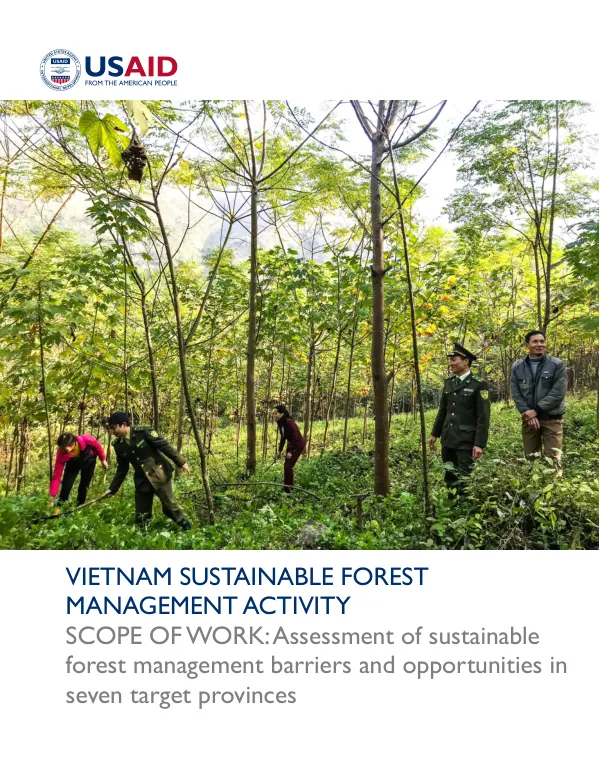
Vietnam Sustainable Forest Management Activity: Assessment of Sustainable Forest Management Barriers and Opportunities in Seven Target Provinces
Sign inDAI GLOBAL, LLC
Vietnam Sustainable Forest Management Activity: Assessment of Sustainable Forest Management Barriers and Opportunities in Seven Target Provinces
The Vietnam Sustainable Forest Management Activity aims to reduce carbon emissions associated with deforestation, degradation of natural forests, and poor plantation management in Vietnam.
2021 · 17 pages
Sign in to readA free account is required to download.
Abstract
The activity takes a "Green Prosperity" approach to strengthen local communities' ability to protect their natural resource base and reduce emissions while building a strong foundation for sustainable livelihoods and equitable economic growth. The activity will be implemented in seven provinces: Lao Cai, Son La, Hoa Binh, Nghe An, Thanh Hoa, Quang Tri, and Quang Nam. The goals of the activity are to avoid carbon emission from natural forests, increase carbon sequestration through better management of plantation forests, and improve quality, diversity, and production of natural forests. The activity will achieve these goals by enhancing application of sustainable practices and implementing forestry laws and regulations in the management of protection and production forests. It aims to achieve five mutually reinforcing objectives: improve and expand community forest management, increase conservation-friendly enterprises in forest-dependent communities, increase functionality of law enforcement system for forest crimes, improve production forest management practices, and mobilize domestic resources for forest management and protection. Under the objective of improving production forest management practices, there are three main tasks: increase production of sustainable timber by small-scale foresters, increase demand from processors for certified timber, and develop market linkages between timber producers and industry. The growing international and local furniture market has created a high demand for timber and wood chips, while an insufficient domestic supply drives indiscriminate importation of timber from abroad. Sustainable plantation management can improve yields of existing plantation lands, increasing domestic availability of wood products, and indirectly decreasing the demand for illegal wood products. The activity will focus on improving management practices of acacia plantations, which can lead to increased carbon sequestration, estimated at 49 metric tons of CO2 equivalent (per hectare per year) compared to business as usual. Plantations with improved management practices are also eligible for certification programs such as the Forest Stewardship Council (FSC). Certified timber products command a market premium, and there is a current shortfall of FSC-certified wood products available in Vietnam. However, smallholders, which make up the majority of acacia farmers in Vietnam, face significant barriers for certification, including high upfront costs, increased risk of income loss due to storms or fires, delayed income, limited technical capacity, and value chains adapted to short rotations. The assessment teams will collect information on barriers regarding sustainable forest management and certification in provincial, district, commune, forestry cooperatives, timber processors, nurseries, and farmers. They will also find opportunities for designing and implementing sustainable forest management and forest certification in the target provinces. The assessment will focus on seven target provinces: Son La, Hoa Binh, Lao Cai, Thanh Hoa, Nghe An, Quang Tri, and Quang Nam. The assessment teams will meet with various stakeholders, including the Vietnam Forest Administration, Management Board of Forestry Projects, Provincial/District Department of Agriculture and Rural Development, Provincial/District Forest Protection Department, timber processors and buyers, and potential nurseries.