USAID DEC
Village Insurance-Savings Accounts (VISAs): Integrating the VISA Model Into Existing Systems
Sign inUSAID
Village Insurance-Savings Accounts (VISAs): Integrating the VISA Model Into Existing Systems
The Village Insurance-Savings Accounts (VISAs) model is an innovative approach to risk management and resilience for vulnerable smallholder agriculturalists.
2016 · 2 pages
Sign in to readA free account is required to download.
Abstract
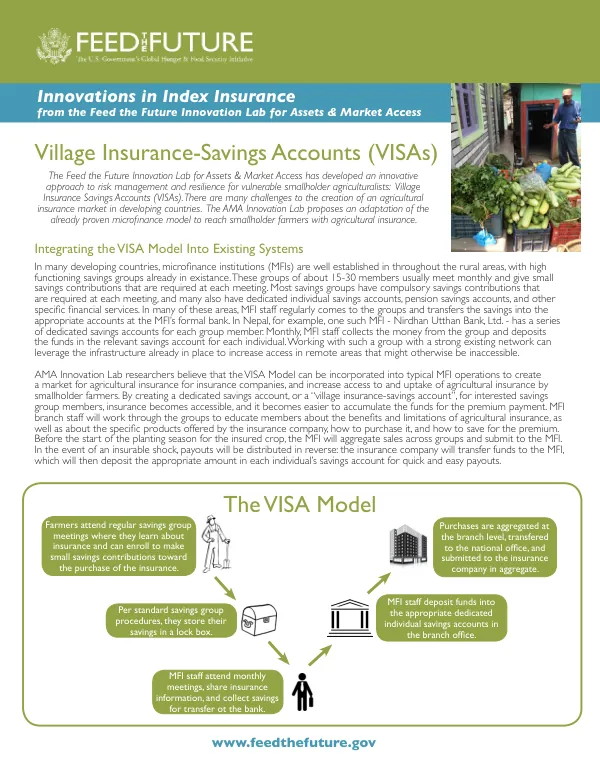
This model integrates the existing microfinance infrastructure in rural areas to increase access to and uptake of agricultural insurance by smallholder farmers. The VISA model leverages the existing network of microfinance institutions (MFIs) and their savings groups to create a dedicated savings account for interested group members, making insurance accessible and easier to accumulate the funds for premium payments. In many developing countries, MFIs have well-established savings groups in rural areas, with high-functioning groups of 15-30 members who meet monthly and contribute small savings. These groups often have compulsory savings contributions and dedicated individual savings accounts, pension savings accounts, and other specific financial services. By working with such groups, the VISA model can increase access to remote areas that might otherwise be inaccessible. The AMA Innovation Lab researchers believe that the VISA model can be incorporated into typical MFI operations to create a market for agricultural insurance for insurance companies. The VISA model aggregates small purchases into one larger purchase, reducing the operating costs of insurance companies and increasing sales. This can make agricultural insurance a feasible opportunity for insurance companies. In the event of an insurable shock, payouts will be distributed in reverse: the insurance company will transfer funds to the MFI, which will then deposit the appropriate amount in each individual's savings account for quick and easy payouts. The model also facilitates education and savings plan development with the MFI staff, enabling farmers to save for months in advance and expanding their existing relationship with the MFI. The VISA model addresses several challenges specific to bringing agricultural insurance to remote, rural communities. Insurance companies face high costs and low sales due to the small market size and remote locations. Farmers lack knowledge and trust of insurance, and may not have the premium readily available when insurance is offered. The VISA model uses savings groups to aggregate small purchases, reducing transaction costs for insurers and facilitating knowledge and trust of insurance. By working with a trusted financial partner and established groups, the model can overcome these challenges and increase access to agricultural insurance. The VISA model is being piloted in Nepal, in collaboration with Feed the Future, USAID, the Government of Nepal, and private sector partners. The AMA Innovation Lab will rigorously evaluate the impacts of the VISA model, including the innovative agricultural insurance product, to inform development partners about the potential impacts of these innovations. The model will be tested in additional contexts with other products to see how broadly it can be applied to overcome the challenges to agricultural insurance.