USAID DEC
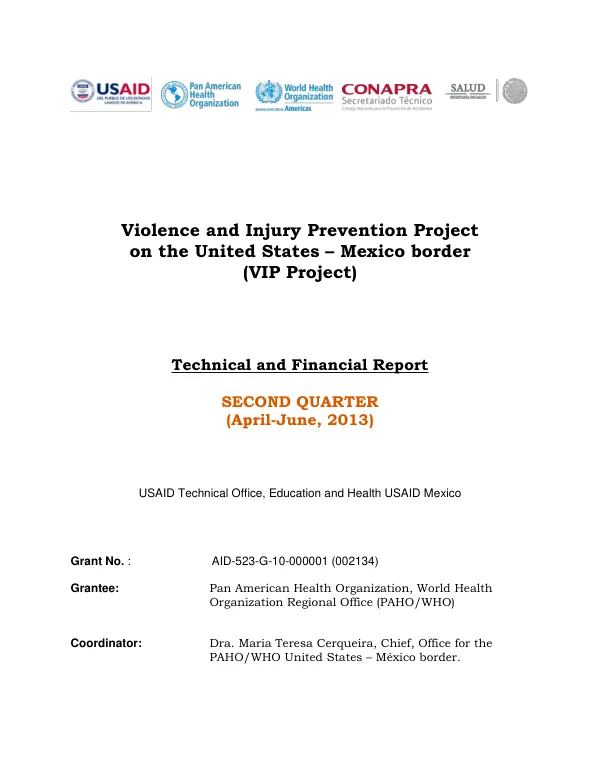
Violence and Injury Prevention Project (VIP Project) Technical and Financial Report
The Violence and Injury Prevention Project (VIP Project) on the United States-Mexico border was implemented by the Pan American Health Organization, World Health Organization Regional Office (PAHO/WHO) from September 2011 to April 2013.
2013 · 8 pages
Sign in to readA free account is required to download.
Abstract
The project aimed to prevent violence and injuries in Ciudad Juarez, Mexico, through a comprehensive approach that included training specialists, mental health training for primary care professionals, and community-based initiatives. Training specialists played a crucial role in the project, with 136 psychologists and psychotherapists trained in workshops covering topics such as mental health, care of victims of violence, and sexual abuse in children. The training programs were highly successful, with participants showing a strong adoption rate for sustainable agriculture techniques and mental health practices. The project also focused on community-based initiatives, including art workshops and exhibitions. A photo-diary was prepared to document the process and products of the art workshops, which were showcased in an exhibition titled "Art for the Prevention of Violence and Injuries and Management of Emotions." The exhibition aimed to acknowledge the work of community promoters specialized in mental health and violence prevention. The VIP Project had a strong technical advisory committee, which provided guidance and support to the working team and consultants. The committee was composed of experts in mental health, violence prevention, and community health, who contributed to the project's effectiveness by identifying strengths and weaknesses, and making recommendations for improvement. The project's strengths included the number of products prepared through the project, the coordination structure, and the interaction among technical components. However, weaknesses were identified, including the lack of participation of civil society in discussions and decisions, the absence of a family approach, and the need for a clearer reference framework. Based on the strengths and weaknesses identified, the technical advisory committee made several recommendations, including the establishment of an organizing and coordinating structure to ensure the continuity of project products, the definition of basic indicators for follow-up, and the analysis of policies and practices existing as of the project. The committee also recommended evaluating the possibility of carrying out a study to collect information on the effect of interventions in violence prevention. Recommendations were also made on the mental health component, including exploring the possibility of carrying out a study on the relationship between violence and mental health, introducing elements from the IESM-WHO into the Observatory, and evaluating the possibility of including promoters in mental health services. The project's findings and recommendations have the potential to inform future initiatives aimed at preventing violence and injuries in the region.