ABT ASSOCIATES
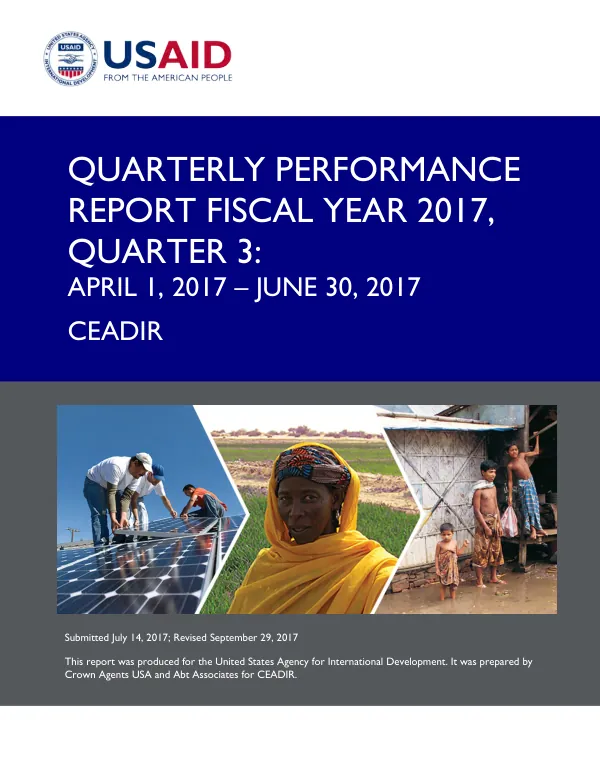
Quarterly Performance Report Fiscal Year 2017, Quarter 3
Climate Economic Analysis for Development, Investment, and Resilience (CEADIR) is a global task order supported by the Bureau of Economic Growth, Education, and Environment (E3) of the United States Agency for International Development (USAID).
2017 · 34 pages
Sign in to readA free account is required to download.
Abstract
The task order is designed to provide technical assistance and capacity development for assessments, economic analysis, planning, and mobilization of funds for low emission development strategies (LEDS) and National Adaptation Plans (NAPs). CEADIR's primary objective is to help USAID, partner governments, private sector, and civil society make the financial and economic case for investing in climate change mitigation and adaptation. The CEADIR task order spans the three U.S. Government global climate change pillars: clean energy (CE), sustainable landscapes (SL), and adaptation (AD). The task order is implemented in collaboration with the Global Climate Change Office (GCC) and the E3's E3 office. The CEADIR team provides technical assistance to USAID missions, partner governments, and other stakeholders to support the development of low emission development strategies and National Adaptation Plans. CEADIR's technical assistance includes support for the development of clean energy policies, regulations, and regulations, and the promotion of sustainable land use practices. The team also provides capacity development for assessments, economic analysis, and planning, and mobilizes funds for low emission development strategies and National Adaptation Plans. CEADIR's work is guided by the principles of the Paris Agreement and the Sustainable Development Goals (SDGs). The CEADIR task order is implemented in several regions, including Latin America and the Caribbean, Africa, and Asia. The team works closely with USAID missions, partner governments, and other stakeholders to support the development of low emission development strategies and National Adaptation Plans. CEADIR's work is focused on supporting the transition to a low-carbon economy and promoting sustainable development. The CEADIR team has made significant progress in implementing the task order. The team has provided technical assistance to several USAID missions and partner governments, and has supported the development of low emission development strategies and National Adaptation Plans. CEADIR has also mobilized funds for several projects, including the development of a clean energy policy in El Salvador and the promotion of sustainable land use practices in Peru. CEADIR's work has been recognized by several stakeholders, including the United States Agency for International Development (USAID] and the Global Environment Facility (GEF). The team has also received recognition for its work on low emission development strategies and National Adaptation Plans. The CEADIR task order is expected to continue until 2020. The team will continue to provide technical assistance to USAID missions, partner governments, and other stakeholders to support the development of low emission development strategies and National Adaptation Plans. CEADIR will also continue to mobilize funds for several projects, including the development of a clean energy policy in El Salvador and the promotion of sustainable land use practices in Peru. CEADIR's work is guided by the principles of the Paris Agreement and the Sustainable Development Goals (SDGs