 1990
1990USAID DEC
USAID. BUR. FOR SCIENCE AND TECHNOLOGY. OFC. OF NUTRITION
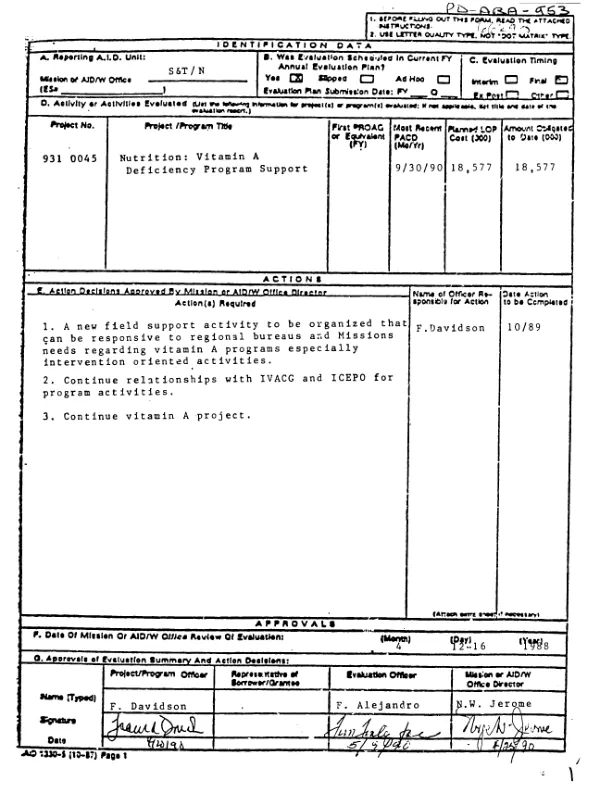
Evaluates project to assist LDC"s in implementing programs to alleviate vitamin A deficiency.
Brown, R. · 1981
Abstract
Evaluation covers the period 6/78-8/81 and is based on document review and interviews with A.I.D. and host government personnel. Given its limited funding, the project has progressed excellently due to several factors. Specifically, there is a growing awareness and acceptance of the International Vitamin A Consultative Group as a key advisory and coordinative body; AID-funded preliminary assessment surveys conducted by the World Health Organization confirmed that vitamin A deficiency is a public health problem in Africa and stimulated interventions; and A.I.D., using the International Center for Epidemiologic and Preventive Opthamology (established through a cooperative agreement with Johns Hopkins University), now has the ability to rapidly respond to LDC needs. The project has thus provided problem identification and/or program implementation assistance to 12 additional countries and has continued to assist four of the nine countries previously reached; the remaining five countries no longer require assistance. Distribution of vitamin A capsules is underway in Indonesia, Haiti, Bangladesh, Kenya, and India and will soon begin in Tanzania, Malawi, and Zambia. Further, subsidized capsule distribution is scheduled for Indonesia. A cost-effective method of vitamin A fortification of sugar was developed and tested in Guatemala; is being used there as well as in Honduras, Panama, and Brazil; and is being considered for use in Africa. Large-scale fortification of monosodium glutamate has been hampered by technical problems, however, and will be further researched in the Philippines and Indonesia. Finally, the Asian Vegetable and Development Center is promoting home-grown foods as a source of vitamin A in Taiwan, Indonesia, the Philippines, and Thailand. It is recommended that national and regional vitamin A deficiency prevalence surveys and interventions be funded through Missions rather than AID/W and that the contribution of this project be limited to short-term technical assistance for these efforts. A management review is also recommended
Connected topics
Classification
USAID DEC