USAID
Water Resources Profile Series: Kenya Water Resources Profile Overview
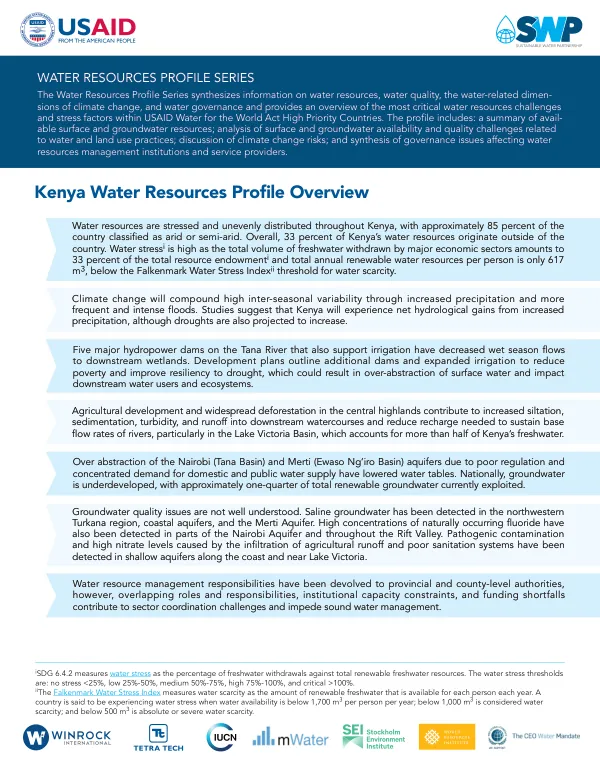
Kenya's water resources are stressed and unevenly distributed throughout the country, with approximately 85 percent classified as arid or semi-arid.
2021 · 11 pages
Sign in to readA free account is required to download.
Abstract
The total volume of freshwater withdrawn by major economic sectors amounts to 33 percent of the total resource endowment, and total annual renewable water resources per person is only 617 m3, below the Falkenmark Water Stress Index threshold for water scarcity. Climate change will compound high inter-seasonal variability through increased precipitation and more frequent and intense floods, although studies suggest that Kenya will experience net hydrological gains from increased precipitation, with droughts also projected to increase. Five major hydropower dams on the Tana River that also support irrigation have decreased wet season flows to downstream wetlands. Development plans outline additional dams and expanded irrigation to reduce poverty and improve resiliency to drought, which could result in over-abstraction of surface water and impact downstream water users and ecosystems. Agricultural development and widespread deforestation in the central highlands contribute to increased siltation, sedimentation, turbidity, and runoff into downstream watercourses and reduce recharge needed to sustain base flow rates of rivers, particularly in the Lake Victoria Basin, which accounts for more than half of Kenya's freshwater. Over abstraction of the Nairobi (Tana Basin) and Merti (Ewaso Ng'iro Basin) aquifers due to poor regulation and concentrated demand for domestic and public water supply have lowered water tables. Nationally, groundwater is underdeveloped, with approximately one-quarter of total renewable groundwater currently exploited. Groundwater quality issues are not well understood, with saline groundwater detected in the northwestern Turkana region, coastal aquifers, and the Merti Aquifer, as well as high concentrations of naturally occurring fluoride in parts of the Nairobi Aquifer and throughout the Rift Valley. Water resource management responsibilities have been devolved to provincial and county-level authorities, however, overlapping roles and responsibilities, institutional capacity constraints, and funding shortfalls contribute to sector coordination challenges and impede sound water management. Most of Kenya is arid or semi-arid, and three-quarters of all surface water originate in the central highlands. Lake Victoria and the Tana River, which is the longest in Kenya, are the two main surface water bodies. The highest-yielding aquifers are in the Rift Valley, Athi, Tana, and Ewaso Ng'iro Basins, although recharge rates are often very low in the arid and semi-arid zones. Surface water resources are primarily sourced from five basins, which account for 90 percent of Kenya's total annual renewable supply. The Lake Victoria Basin is the most productive, accounting for 59 percent of surface water and 54 percent of total renewable freshwater. It features several important but relatively short rivers that drain into Lake Victoria, including the Nzoia, Yala, Nyando, Sondu, and Gucha. The Tana River Basin supplies 19 percent of freshwater resources and includes the Thika River, which is a key source of water for Nairobi. The Rift Valley Basin is an internal drainage basin with no outlets, and its headwaters are in the Mau Forest Complex.