WORLD EDUCATION INTERNATIONAL
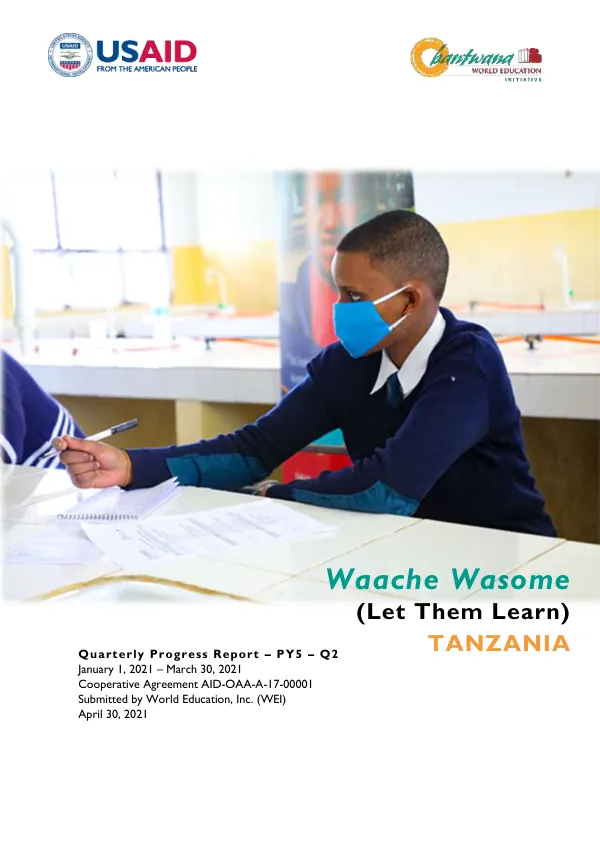
Waache Wasome (“Let Them Learn”) Tanzania | PY5 Q2 Quarterly Progress Report
Waache Wasome (“Let Them Learn”) Tanzania | PY5 Q2 Quarterly Progress Report This reporting quarter kicked off with the launch of the new academic year in project schools.
2021 · 109 pages
Sign in to readA free account is required to download.
Abstract
Partner schools completed their student intake, registration, and planning processes, while Waache Wasome project staff and local officials worked closely with school administrators, teachers, and students to begin in-school activities for the last full year of the program. Activities took place within the context of a COVID-19 upsurge, which impacted staff and participant gatherings, but most activities were accomplished. Objective 1: Building Protective Assets of Girls through Protect Our Youth (POY) Activities in Schools The multi-grade POY Clubs enrolled 1,798 new Form 1 members, with 1,206 girls, bringing total membership across 108 schools to 5,314 (3,177 girls). While not all schools ran regular weekly sessions due to registration and class kick-off, 2,096 students (1,074 girls) attended POY Club sessions, attending 80% of delivered sessions. POY Clubs from 35 schools carried out "extra" activities, mainly at school assemblies and initial parent-teacher meetings, reaching 15,332 students (8,156 girls) and hundreds of parents and teachers with messages around protective assets and girls' education. The project trained 372 peer leaders (187 girls) from 92 project schools. With the announcement of Form 4 exam results, 154 POY Club students (58 girls) attained the required ranking to move on to higher school. Teachers and school teachers attributed improved national results to POY Clubs and Science and Mathematics Subject Clubs. A POY member from Musoma DC became the first girl to gain the top score in Form 4 national results. Objective 2: Building Capacity of Families to Support Girls' Education During this period, 110 new savings and lending groups were formed, with 2,612 additional members (2,007 female) joining the platform. Total active membership of LIMCA stood at 11,930 (2,851 male, and 9,079 female) at the end of Q2. Training of EEVs and cascading of the work to LIMCA leadership and members was conducted across several categories: * Management Committee training was conducted for 44 EEVs (39 female) and 517 group members (356 female) from 139 groups formed in Q1 and Q2. * Business Skills training was delivered to 134 EEVs (101 female), who cascaded the training to 1,726 LIMCA members (1,249 female) this quarter. * Parenting Skills TOTs were held for 34 EEVs, and 737 parents (475 female) participated in parenting sessions facilitated by EEVs during their weekly savings meetings. * WEI completed TOTs for local government officials on facilitating GBV dialogues, and officials facilitated GBV discussions with 1,398 LIMCA members (953 female) this quarter. LIMCA members saved over half a billion Tanzanian shillings (TZS 503.6 million or US$ 218,990) and issued 7,180 loans valued at TZS 777.94 million (US$ 338,234). As students began their new school year, LIMCA members contributed TZS 22.95 million (US$ 9,979) to support 2,149 vulnerable students (67% of them girls). Objective 3: Fostering a Girl-Friendly and Supportive School Environment With teacher training on SRGBV completed in Q4, the focus during this period was on capacitating School Boards to exercise their role in SRGBV prevention and support for at-risk students. Establishing a common understanding of the importance and value of the Dropout Early Warning System (DEWS) was also a priority. Science and Mathematics Clubs were formed, with 8,662 students registered (5,118 girls) and training delivered to 585 club peer leaders (388 girls). The Design Squad initiative was launched in Karatu, with 300 students (200 girls) registered. Objective 4: Providing Alternative Education Pathways for Girls Who Have Dropped Out of Secondary School This objective is not covered in the provided text.