USAID
Quarterly Progress Report Y3 Q2: Waache Wasome Project
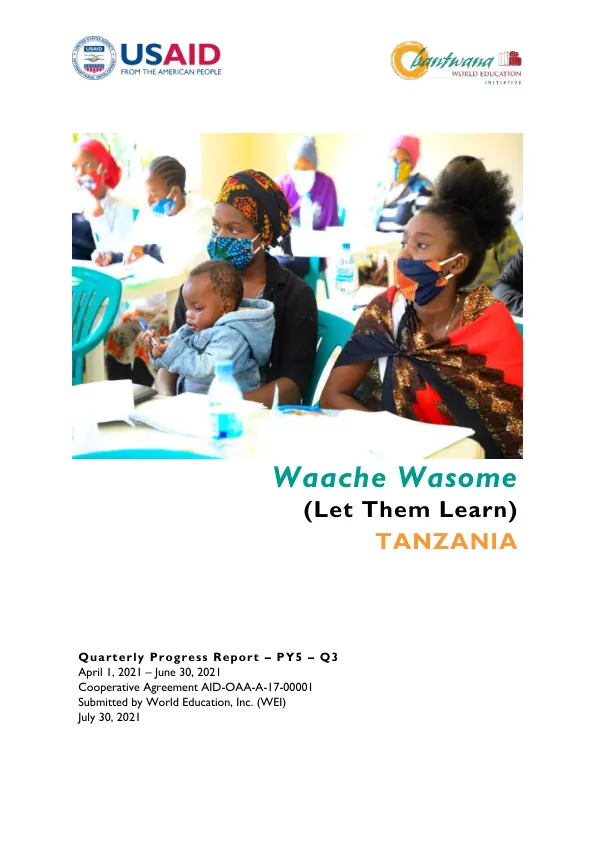
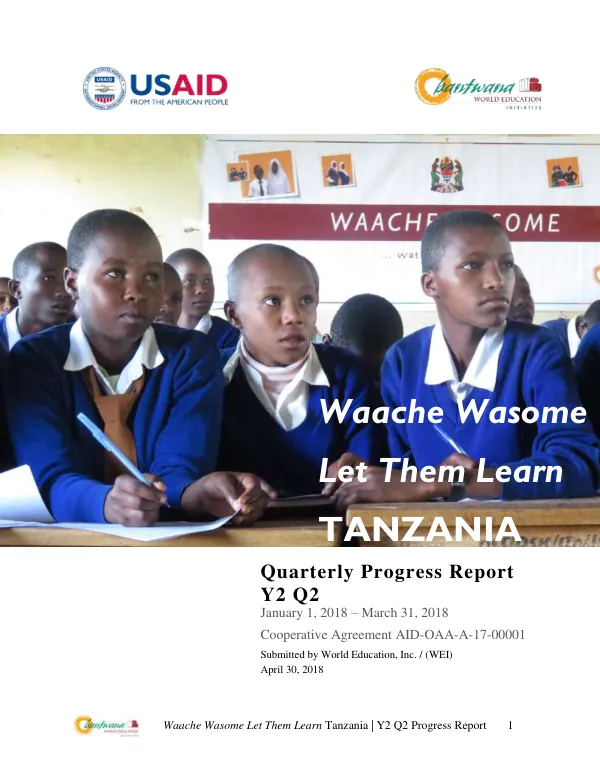
The Waache Wasome project, funded by USAID, aims to increase adolescent girls' participation and retention in secondary school or in alternate educational pathways.
2019 · 80 pages
Sign in to readA free account is required to download.
Abstract
The project is implemented by World Education, Inc. (WEI) in collaboration with local partners in Tanzania. The project's objectives are to build the agency, knowledge, and protective assets of girls in secondary school, increase family commitment and capacity to invest in girls' education, foster a girl-friendly and supportive school environment, and provide alternative education pathways for girls who have dropped out of secondary school due to pregnancy and/or early marriage. Implementation of the project's objectives began in January 2019, with a focus on delivering outputs and achieving positive outcomes. The project supported the introduction and formation of new Protect Our Youth (POY) clubs, which serve 4,834 students, including 2,909 girls, in 36 project schools. Student peer leaders and POY Club matrons/patrons were trained in facilitating the standard POY curriculum and formulating new activities to maintain interest and engagement of continuing students. Under Objective 2, the project implemented the Livelihoods Improvement for Mothers and Caregivers (LIMCA) strategy, which saw 249 LIMCA savings and lending groups in operation. These groups saved TZS 266,837,328 and loaned TZS 462,811,085 during the quarter. WEI delivered training on business skills and positive parenting for LIMCA members and facilitated group sessions with Council and Ward-level Agriculture Field Officers to improve knowledge and skills on income-generating activities. The project also supported the establishment of 144 Science and Mathematics Subject Clubs (SMSCs), covering a total of 14,315 students, including 50% girls. WEI distributed national science examination papers and formats to each school as reference and revision aids for students. Discussions were underway with representatives of WGBH Educational Foundation and Tanzania Bora for the delivery of Design Squad hands-on STEM learning sessions and a residential coding camp for girls. In relation to Objective 4, the project reached out to more than 300 out-of-school girls, identified with the help of local village and ward officials and stakeholders in three project districts. Through community liaising, 23 potential safe spaces were identified, and the formation of out-of-school-study groups (OSSGs) was initiated. 44 peer leaders and 22 adult facilitators were oriented and trained, and a training of trainers was delivered on the Early Childhood Stimulation (ECS) curriculum specifically targeted to the needs of teen mothers in the OSSGs. The project's monitoring and management activities included onsite visits to 75% of the LIMCA groups, home visits to members, and regular meetings with local implementing partners. The project's quarterly progress report highlights notable successes, including eight LIMCA groups accessing no-interest government loans worth TZS 24.3 million, seven LIMCA groups donating 55 bags of cement for building additional classroom space, and collectively 66 LIMCA groups supporting 304 adolescents with school-related needs. The project's activities and outcomes demonstrate its commitment to increasing adolescent girls' participation and retention in secondary school or in alternate educational pathways.