WORLD EDUCATION INTERNATIONAL
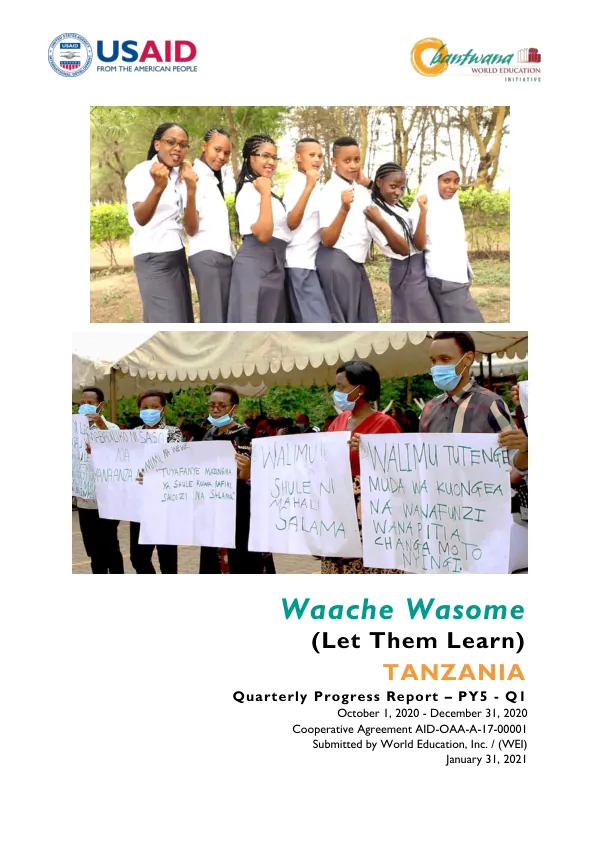
Waache Wasome (“Let Them Learn”) Tanzania | Y5 Q1 Quarterly Progress Report
The Waache Wasome ("Let Them Learn") Tanzania project, implemented by World Education, Inc.
2021 · 91 pages
Sign in to readA free account is required to download.
Abstract
(WEI), marked significant progress in the first quarter of Program Year 5 (PY5) under the Phase 3 expansion. The project, which aims to improve the lives of adolescent girls and young women, expanded to include an additional 41 public secondary schools, a fifth council, and a new project component. During the quarter, the WEI team, in collaboration with local government officials and subgrantees, Africa Inland Church of Tanzania (AICT), Rafiki Social Development Organization (Rafiki-SDO), and Service, Health, and Development for People Living with HIV/AIDS (SHDEPHA+), implemented planned activities despite the ongoing global public health challenge and electioneering across the country. The team engaged with council, ward, and village officials to promote the formation of savings and lending groups in expansion areas and identified and enrolled vulnerable adolescent girls in the out-of-school support program. The project's in-school programming adjusted to work around the intense focus on final examinations, with the team engaging with teachers in all expansion schools and with School Boards to deliver essential training in fostering a more conducive learning environment through preventing and reducing the incidence of school-related gender-based violence (SRGBV). The team also continued to reach thousands of students through Protect Our Youth (POY) and Science and Mathematics Subject Club activities. The COVID-19 pandemic presented a significant challenge, requiring a reconfiguration of capacity building and training activities to observe prevention protocols and social distancing. The team adapted to a "hybrid" model that uses audio-visual recordings, SMS content, radio announcements, and other new modalities for communication, monitoring, tracking, and verifying data. The WEI team is grateful to all project partners, stakeholders, and participants for their commitment, resiliency, and innovation in implementing interventions to the highest standards amid challenges that threaten community health and economic situations. Objective 1 - Building protective assets of adolescent girls through Protect Our Youth Club activities in schools - achieved significant progress, with the establishment of POY Clubs and training of new patrons/matrons and club peer leaders for all 41 Phase 3 expansion schools. During the quarter, the last of 20 new POY Clubs were formed in Arusha City and enrolled 745 students (457 girls), and 79 patrons and matrons were trained in supporting effective functioning of POY Clubs. Objective 2 - Building Capacity of Families to Support Girls' Education - saw the formation of 87 new LIMCA groups, with 2,214 additional members joining both the new groups and existing groups. WEI, in collaboration with subgrantees, recruited and delivered initial training on the LIMCA model to 63 (40 female) Economic Empowerment Volunteers and Management Committee Training to 54 (47 female) EEVs. Previously trained EEVs rolled out both parenting skills (to 1,788 LIMCA members) and business skills training to LIMCA members. The project's progress in the first quarter of PY5 under the Phase 3 expansion has established a firm basis for continued expansion, consolidation, and transition during 2021.