USAID DEC
Wan Kanyakla (We are together): Community transformations in Kenya following a social network intervention for HIV care
Sign inJOHNS HOPKINS UNIVERSITY
Wan Kanyakla (We are together): Community transformations in Kenya following a social network intervention for HIV care
The "Wan Kanyakla" social network intervention in Kenya aimed to improve HIV care and treatment outcomes among individuals and their social networks.
2015 · 2 pages
Sign in to readA free account is required to download.
Abstract
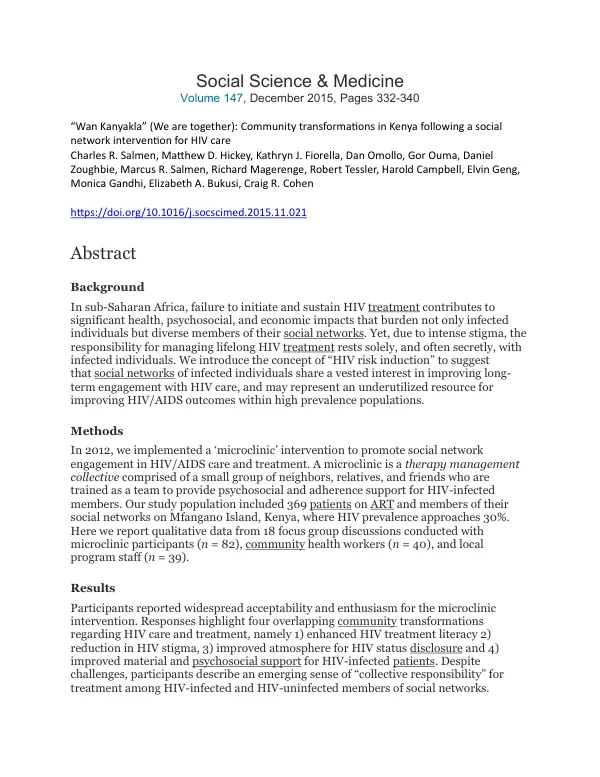
Implemented in 2012 on Mfangano Island, where HIV prevalence approaches 30%, the intervention involved training a small group of neighbors, relatives, and friends as a team to provide psychosocial and adherence support for HIV-infected members. This collective, known as a microclinic, comprised 369 patients on antiretroviral therapy (ART) and their social networks. The microclinic intervention promoted social network engagement in HIV/AIDS care and treatment, with the goal of reframing the continuum of HIV care from a secretive individual journey into a network-oriented cycle of engagement. Qualitative data from 18 focus group discussions conducted with microclinic participants, community health workers, and local program staff highlighted four overlapping community transformations regarding HIV care and treatment. These transformations included enhanced HIV treatment literacy, reduction in HIV stigma, improved atmosphere for HIV status disclosure, and improved material and psychosocial support for HIV-infected patients. Participants reported widespread acceptability and enthusiasm for the microclinic intervention, describing an emerging sense of "collective responsibility" for treatment among HIV-infected and HIV-uninfected members of social networks. This shift in perspective was attributed to the microclinic's focus on social network engagement and the provision of psychosocial and adherence support. The intervention's success was also linked to the training of community health workers and local program staff, who played a crucial role in facilitating the microclinic's activities and promoting HIV treatment literacy. The microclinic intervention's impact on HIV care and treatment outcomes was significant, with participants reporting improved material and psychosocial support for HIV-infected patients. The reduction in HIV stigma and improved atmosphere for HIV status disclosure also contributed to increased engagement with HIV care and treatment. The study's findings suggest that social networks of HIV-infected individuals share a vested interest in improving long-term engagement with HIV care, and may represent an underutilized resource for improving HIV/AIDS outcomes within high prevalence populations. The microclinic intervention's success in promoting social network engagement and improving HIV care and treatment outcomes has important implications for HIV/AIDS programming in sub-Saharan Africa. By reframing the continuum of HIV care from a secretive individual journey into a network-oriented cycle of engagement, the microclinic intervention offers a promising approach to improving HIV/AIDS outcomes and reducing the burden of the disease on individuals and their social networks.