USAID
Latest News from USAID Water - October 2016 Global Waters
The USAID Water program has been actively addressing water, sanitation, and hygiene (WASH) challenges in various countries.
2016 · 3 pages
Sign in to readA free account is required to download.
Abstract
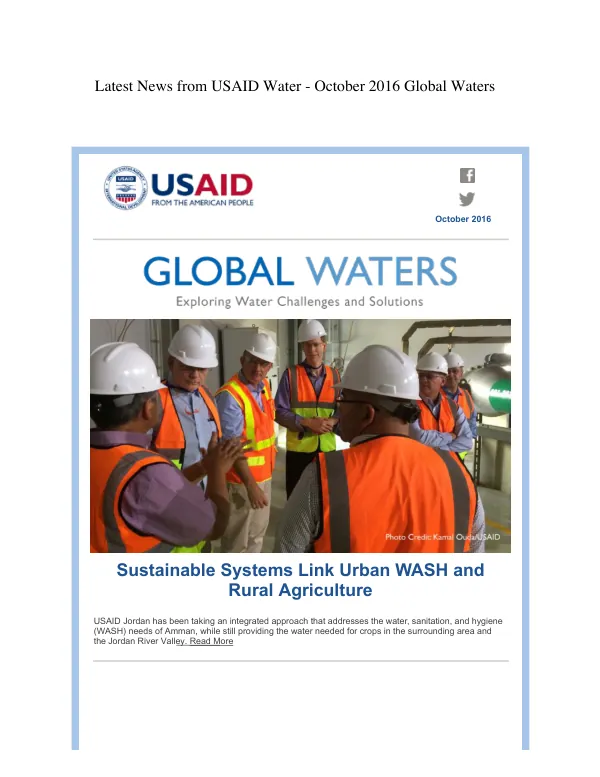
In Jordan, USAID has taken an integrated approach to address the WASH needs of Amman while providing water for crops in the surrounding area and the Jordan River Valley. This approach involves linking urban WASH systems with rural agriculture, ensuring a sustainable balance between water use for human consumption and agricultural purposes. In Kenya, researchers have developed the Povu Poa, an innovative handwashing station designed for areas without access to piped water. Funded by USAID's Development Innovation Ventures program, the Povu Poa aims to improve handwashing practices in communities with limited access to clean water. The handwashing station is equipped with a water tank and a handwashing basin, making it an effective solution for promoting hygiene in areas with limited water resources. In Bangladesh, a handwashing behavior change pilot project used subconscious environmental cues, known as "nudging," to encourage improved handwashing practices. The project, led by Robert Dreibelbis, demonstrated the effectiveness of using subtle cues to influence behavior and promote hygiene. The project's findings have significant implications for WASH programs worldwide, highlighting the potential of behavioral interventions to drive positive change. In India, USAID is supporting efforts to promote sustainable water and sanitation management through city-to-city exchanges. Global Water Coordinator Christian Holmes describes how USAID is facilitating exchanges between cities to share best practices and promote sustainable water management. This approach aims to improve water and sanitation services in Indian cities, ultimately contributing to the country's Swachh Bharat initiative. In the Philippines, USAID's Be Secure Project has been working to improve water management and prepare communities to weather climate change impacts. The project has been particularly active in cities and towns devastated by Typhoon Haiyan, providing critical support to communities in need. By improving water management and promoting resilience, the project aims to reduce the vulnerability of communities to climate-related disasters. In India, a team led by Natasha Wright has developed an electrodiaylsis reversal technology that shows promise for addressing water scarcity in off-grid communities. The technology, which won the Desal Prize, could provide a sustainable solution for communities in sun-rich areas of Africa, Asia, and the Middle East. The project's findings highlight the potential of innovative technologies to address water challenges in some of the world's most water-scarce regions.