USAID DEC
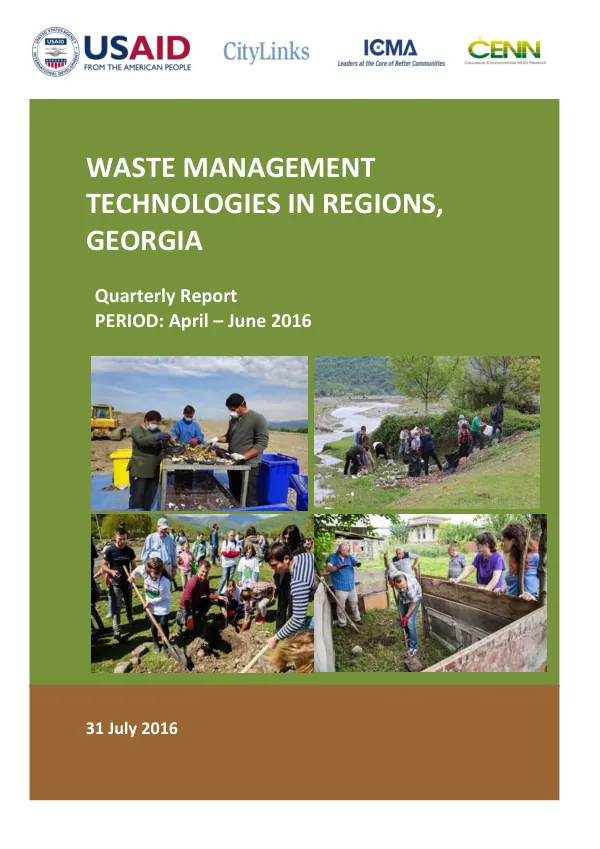
Waste Management Technologies in Regions, Georgia Quarterly Report April – June, 2016
Sign inINTERNATIONAL CITY AND COUNTY MANAGEMENT ASSOCIATION
Waste Management Technologies in Regions, Georgia Quarterly Report April – June, 2016
The USAID Waste Management Technologies in Regions Program (WMTR) was awarded to International City/County Management Association (ICMA) on March 18, 2014, under Cooperative Agreement AID 114-LA-14-00001.
2016 · 34 pages
Sign in to readA free account is required to download.
Abstract
The program aims to contribute to the USAID monitoring and evaluation framework objectives and results, including inclusive and sustainable growth, responsible management and development of Georgia's natural endowments, and improved waste management. The goal of WMTR is to provide professional waste management technical assistance to support waste management system development and recycling in two regions of Georgia — Kakheti and the Autonomous Republic of Adjara. Project activities will promote greenhouse gas (GHG) mitigation and sequestration by developing the waste management sector, including waste collection, recycling, and public awareness. Specifically, this project will enable GHG mitigation and sequestration from the waste sector by enabling the recycling business environment in targeted regions and municipalities; improve waste collection systems; minimize pollution of natural resources from landfills by closing down old, illegal landfills and dumpsites; and enhance public awareness of waste management issues and ensuring public participation in the decision-making and designing process of new waste management systems. WMTR activities combine various components into a comprehensive structure that focuses on technical assistance and capacity/institution building of integrated waste management systems and recycling/composting in two regions of Georgia — Kakheti and Adjara AR. WMTR has four main components: Component 1: Waste Collection and Recycling Systems, Component 2: Private Sector-Led Recycling, Component 3: Waste Management Strategy and Tariff Policy, and Component 4: Communication and Outreach. During the reporting period from April 1 until June 30, 2016, WMTR continued to contend with several assumptions, problems, and barriers, including miscommunication and lack of coordination among donor agencies working in the waste management sector, lack of capacity at the municipal level for addressing waste management issues, and lack of financial resources allocated in municipal budgets for waste management. To address and mitigate the effects these problems and barriers have on the program, WMTR works closely with all tiers of government and stakeholders on capacity building and has been using an intensive communication, outreach, and awareness campaign to promote best practices in waste management and recycling systems. The WMTR team organized a series of tailored trainings for the representatives of local government to improve their capacity for addressing waste management issues. The program is supporting the municipalities to develop municipal waste management plans, which will help them to improve their waste management system and comply with the requirements of the national legislation. The WMTR team also transferred the TDL-500 Portable Gas Analyzer to the Solid Waste Management Company of Georgia (SWMCG) and provided a practical training to the staff of the company on the usage of this equipment. With this activity, the WMTR team developed a capacity of the governmental structure to assess the potential of GHG emissions at the landfills in Georgia. The WMTR team has provided a technical support to the recycling companies in order to increase their capacity, as well as created the platform for the dialogue between the private sector and the government to create a business-friendly environment for waste recycling sector in Georgia. In addition, the WMTR team provided the Self-Governing City of Telavi and Telavi Municipality with bins for separated waste collection (plastic and paper) and thus supported them in optimizing their waste management system. The city will also receive a modern 2010 Kenworth Rear Loader trash truck, with an estimated market value of USD 90,000, in September 2016. This will help the city optimize its waste management system.