USAID DEC
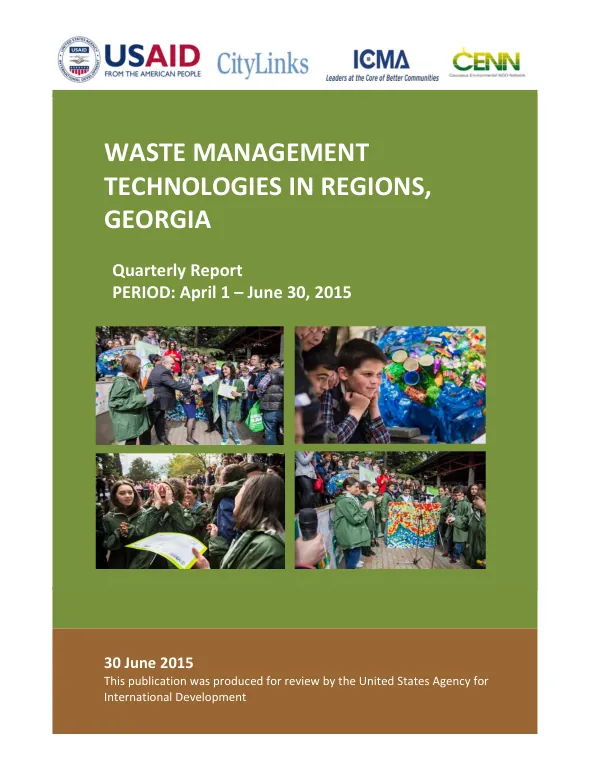
Waste Management Technologies in Regions, Georgia Quarterly Report April – June 2015
Sign inINTERNATIONAL CITY AND COUNTY MANAGEMENT ASSOCIATION
Waste Management Technologies in Regions, Georgia Quarterly Report April – June 2015
The USAID Waste Management Technologies in Regions Program was awarded to International City/County Management Association (ICMA) on March 18, 2014, under Cooperative Agreement AID 114-LA-14-00001.
2015 · 51 pages
Sign in to readA free account is required to download.
Abstract
The program aims to contribute to the USAID monitoring and evaluation framework objectives and results, including inclusive and sustainable growth, responsible management and development of Georgia's natural endowments, and improved waste management. The goal of WMTR is to provide professional waste management technical assistance to support waste management system development and recycling in two regions of Georgia - Kakheti and Adjara AR. WMTR has four main components: Component 1, Waste Collection and Recycling Systems; Component 2, Private Sector-Led Recycling; Component 3, Waste Management Strategy and Tariff Policy; and Component 4, Communication and Outreach. The program also implements cross-cutting activities that support the four components and promote local governance, including empowerment of youth and women, ethnic minorities and people with disabilities, and gender mainstreaming. During the reporting period from April 1 to June 30, 2015, WMTR had to contend with several assumptions, problems, and barriers, including frequent turnover of governmental representatives, miscommunication and lack of coordination between donor agencies working in the waste management sector, lack of communication between state institutions responsible for waste management in Georgia, and non-existence of a waste management strategy and action plan in the country. WMTR prepared the Municipal Waste Management Action Plan Guidelines, but development of concrete action plans for the municipalities should be delayed until the waste management strategy is finalized by the Ministry of Environment and Natural Resource Protection (MoENRP). The program also faced challenges related to lack of financial resources in the municipal budgets allocated for waste management issues, lack of technique and equipment in the municipalities required for waste collection, and lack of accurate data and information related to waste management. Due to the lack of accurate information required for calculation of the GHG emissions from the existing landfills in the Kakheti Region and Adjara AR, the project could not obtain reliable information to create baseline data. Therefore, it is essential to conduct an actual measurement of GHG emissions from the existing landfills. To mitigate the potential problems and barriers, WMTR works closely with all tiers of government and other stakeholders in capacity building and has been using an intensive communication, outreach, and awareness campaign to promote best practices in waste management. The program aims to empower local authorities to manage waste effectively, promote recycling and composting, and reduce greenhouse gas emissions from landfills.