USAID DEC
Water for Africa through Leadership and Institutional Support (WALIS) Six Month Workplan
Sign inDAI
Water for Africa through Leadership and Institutional Support (WALIS) Six Month Workplan
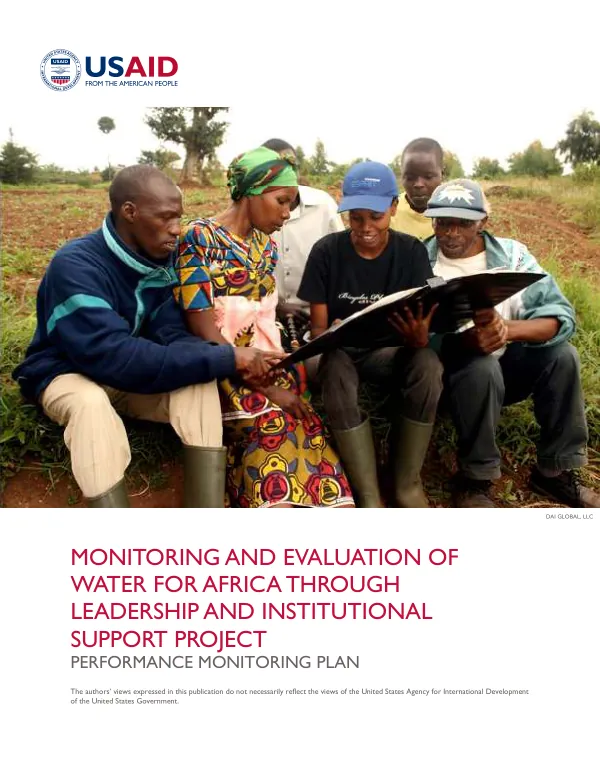
The Water for Africa through Leadership and Institutional Support (WALIS) initiative aims to improve access to clean water and sanitation in Africa.
2015 · 25 pages
Sign in to readA free account is required to download.
Abstract
Despite significant progress made through donor and NGO investments over the past thirty years, a large percentage of Africans still lack access to clean water and proper sanitation. The data that African countries report to the Joint Monitoring Programme (JMP) often masks significant disparities between rural/urban populations and between rich and poor. These statistics also fail to capture the impact of poor water and sanitation access on women and girls who bear the primary responsibility for collecting and managing household water supplies and hygiene. WALIS will work with the USAID Bureau for Africa's Office of Sustainable Development (AFR/SD) to make WALIS a flexible support platform that fosters and promotes a culture of inquiry among African regional and national WASH partners and strengthens WASH programs and programming. The initiative will focus on strengthening a cadre of WASH leaders who will champion the use of data and evidence to drive changes in national policies and practices that deliver improved sanitation and safe water. WALIS will also build demand for better data collection systems and objective analyses that will underpin further improvements in WASH policies, governance, and programs. The WALIS strategic approach is based on the scientific method, which offers an ongoing process of observation, design, testing, and evidence-generation that lends itself to refinement of policies and the generation of tested approaches that can be scaled up for impact. The initiative will cultivate and reinforce a culture of inquiry based on this scientific method, which begins with observations to shape approaches and hypotheses, which are then tested through pilot initiatives. The analysis of these tests/pilots leads to more observations and evidence that in turn, contributes to the further refinement of policies, strategies, and plans, in an iterative process. The six-month work plan for WALIS will focus on effectively engaging with key partners, prioritizing project thematic areas, and implementing specific activities under each task. Task 1 involves developing, monitoring, and analyzing sound sector data, while Task 2 focuses on engaging in targeted research and pilot activities around identified sector constraints. Task 3 aims to strengthen country systems to develop informed policy and engage in sector planning toward sustainable WASH services, and Task 4 seeks to increase the capacity required to support improved collection and use of sector knowledge. The initiative will also prioritize cross-cutting themes such as gender and youth, and will establish a management structure that includes a Chief of Party, additional LTTA personnel, short-term technical assistance, partners, home office support, and operations and systems. The work plan schedule outlines the specific activities and timelines for the six-month period, which will be used to implement the WALIS initiative and achieve its goals.