USAID DEC
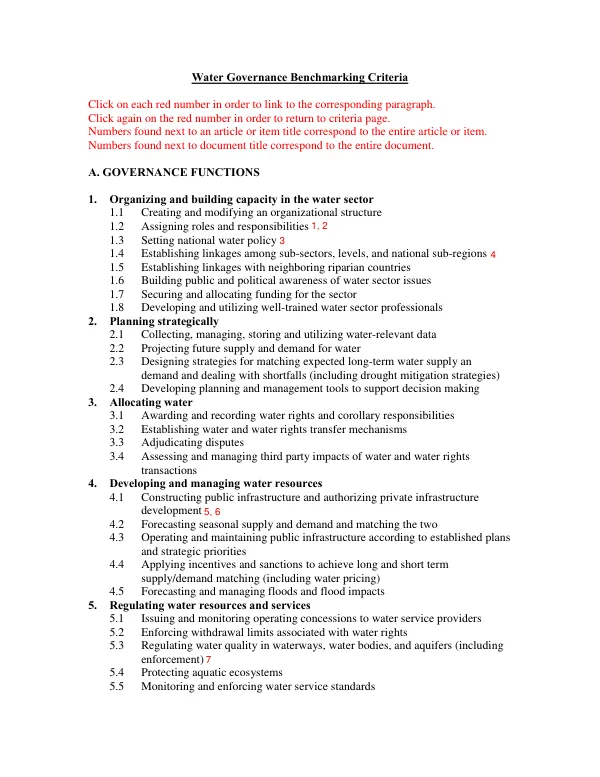
Water Governance Benchmarking Criteria
Governance Functions in Water Management Organizing and building capacity in the water sector is a critical governance function.
2010 · 3 pages
Sign in to readA free account is required to download.
Abstract
This involves creating and establishing an organizational structure, assigning roles and responsibilities, setting national water policy, and establishing linkages among sub-sectors, levels, and national sub-regions. Effective governance requires building public and social awareness of water sector issues, securing and allocating funding for the sector, and developing and utilizing well-trained water sector professionals. Strategic planning is another essential governance function. This involves collecting, managing, and utilizing water-relevant data, projecting future supply and demand for water, designing strategies for matching long-term water supply and demand, and developing planning and management tools to support decision making. Strategic planning also includes forecasting seasonal supply and demand and matching the two, as well as applying incentives and sanctions to achieve long and short-term supply/demand matching. Allocating water is a critical governance function that involves awarding and registering water rights and corresponding responsibilities, establishing water and water transfer mechanisms, adjudicating disputes, and assessing and managing third-party impacts of water and water transactions. Developing and managing water resources is another essential governance function that involves constructing public infrastructure, authorizing private infrastructure development, forecasting seasonal supply and demand, and maintaining public infrastructure according to established plans and priorities. Regulating water resources and services is a critical governance function that involves issuing and monitoring concessions to water service providers, regulating water quality in water bodies and aquifers, protecting aquatic ecosystems, and monitoring and enforcing water service standards. Effective regulation requires transparency, participation, accountability, and accountability, and must be integrated with other governance functions. Governance Process Characteristic: Transparency Transparency is a critical governance process characteristic that involves providing clear and accurate information about water management activities, decisions, and decisions. This includes providing information about water sources, water uses, and water management policies and regulations. Transparency also involves providing opportunities for public participation in water management decisions and ensuring that all stakeholders have access to information and are informed about water management activities. Governance Process Characteristic: Participation Participation is a critical governance process characteristic that involves engaging all stakeholders in water management decisions and ensuring that their views and concerns are taken into account. This includes providing opportunities for public participation in water management decisions, ensuring that all stakeholders have access to information and are informed about water management activities, and involving stakeholders in decision-making processes. Governance Process Characteristic: Accountability and Integrity Accountability and integrity are critical governance process characteristics that involve ensuring that water management decisions and activities are transparent, fair, and fair. This includes ensuring that water management decisions and activities are based on accurate and reliable information, that all stakeholders are treated fairly and equally, and that water management decisions and activities are consistent with water management policies and regulations. Governance Process Characteristic: Rule of Law The rule of law is a critical governance process characteristic that involves ensuring that water management decisions and activities are based on and consistent with water management policies and regulations. This includes ensuring that water management decisions and activities are made in accordance with the law, that all stakeholders are treated fairly and equally, and that water management decisions and activities are consistent with water management policies and regulations. Cross-Cutting Categories: Water Sources Water sources are a critical cross-cutting category that involves identifying and managing water sources, including surface water, groundwater, and derivative water (reclaimed, reused, and desalinated). Effective management of water sources requires ensuring that water is available for all uses, including irrigation, municipal, industrial, environmental, and environmental uses, as well as hydropower, fishery, navigation, recreation, and other uses. Cross-Cutting Categories: Water Uses Water uses are a critical cross-cutting category that involves identifying and managing water uses, including irrigation, municipal, industrial, environmental, and environmental uses, as well as hydropower, fishery, navigation, recreation, and other uses. Effective management of water uses requires ensuring that water is available for all uses, that water is used efficiently and effectively, and that water uses are consistent with water management policies and regulations. Determination of Dhahira Region Water Supply Wellfield Protection Zones The Dhahira Region Water Supply Wellfield Protection Zones were determined in accordance with the Law for Conservation of the Environment and Prevention of Pollution issued by Royal Decree 114/2001, the Law for Protection of Water Resources issued by Royal Decree 29/2000, and the Royal Decree 47/2001 for Ministerial Amendments. The zones were determined to develop water resources, protect water resources, and prevent pollution, exhaustion, and intrusion of saline water. The zones were divided into five areas, each determined according to the coordinates given in Annex 2. The Ministry of Regional Municipalities, Environment, and Water Resources is responsible for managing the Dhahira Region Water Supply Wellfield Protection Zones in coordination with all concerned parties. The Ministry is responsible for achieving the requirements given in Article 1 and for ensuring the safety of groundwater and fulfilling the conditions of protecting water resources in the determined areas. A Working Committee was formed to carry out
Related documents