USAID. MISSION TO EL SALVADOR
Water management
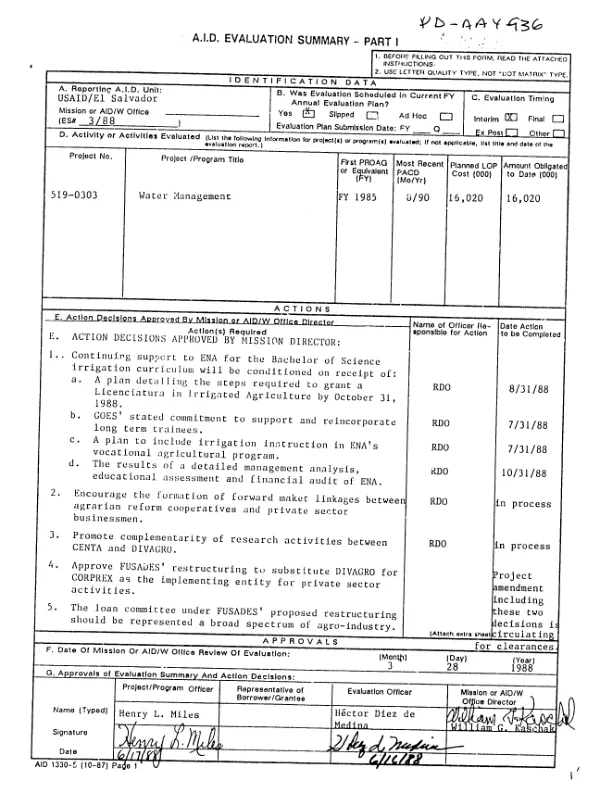
Summarizes interim evaluation (PD-AAY-204) of a project to promote diversified irrigated farming in El Salvador through institution building, technology transfer, training, and credit.
1988
Sign in to readA free account is required to download.
Abstract
External evaluation covers the period FY85-3/88. The project has been hampered by many implementation problems. Due to legal restrictions, it took more than 2 years to establish CORPREX to implement the project"s private sector component. Meanwhile, FUSADES took over these responsibilities and proved capable of carrying out project objectives at a lower cost. It is recommended that FUSADES replace CORPREX in this function. The export market risk guarantee established by the project has attracted little interest, although it is too early to assess its value and the guarantee should be continued at least until the mid-term evaluation. The National School of Agriculture remains the best location for university-level irrigation training. TA has not been available on a continuous basis. As a result, farmer interest has eroded during the last 2 years and even though advisors are now arriving, it will be difficult to recover some of the lost momentum. The interest of the Government of El Salvador (GOES) has also waned; many officials believe that USAID/ES"s interests lie with the private sector and claim that USAID/ES has not followed through with promised equipment and technical support. Many GOES staff members were unaware of their assigned roles in the project due to rapid staff turnover and failure of GOES leaders to transmit project documents. USAID/ES wrongly assumed that GOES personnel fully understood the project agreement, their roles, and responsibilities. Coordination between the public and private sectors has been poor, partly as a result of the private sector"s lack of confidence in the GOES. After an initial attempt at dialogue, the groups went separate ways. The high turnover of USAID/ES staff responsible for project monitoring also contributed to coordination breakdowns. Several lessons were learned. (1) Starting a new area of agricultural production requires much more time, TA, training, and financial support than has been provided under this project. Tasks are made even more difficult by political and social problems and rural sector changes. Not only must the project overcome production and marketing obstacles, but it must also convince individuals to invest in an extremely risky business during a period when confidence is not high; additional incentives to local irrigation equipment suppliers are particularly needed. Future projects should be planned to last at least 8 years. (2) Projects should have top-flight TA from the start. (3) Real perseverance is needed to overcome obstacles to cooperation and collaboration; continuity of Mission personnel backstopping a project is also requisite. (4) A.I.D. must develop its own briefing system and be prepared to provide copies of the most important project documentation.