USAID. MISSION TO JORDAN
Water systems and services management
Evalutes project to improve the water management capabilities of Jordanian public and private organizations and also to upgrade select municipal water and wastewater systems.
Ahmad, Abdullah · 1986
Sign in to readA free account is required to download.
Abstract
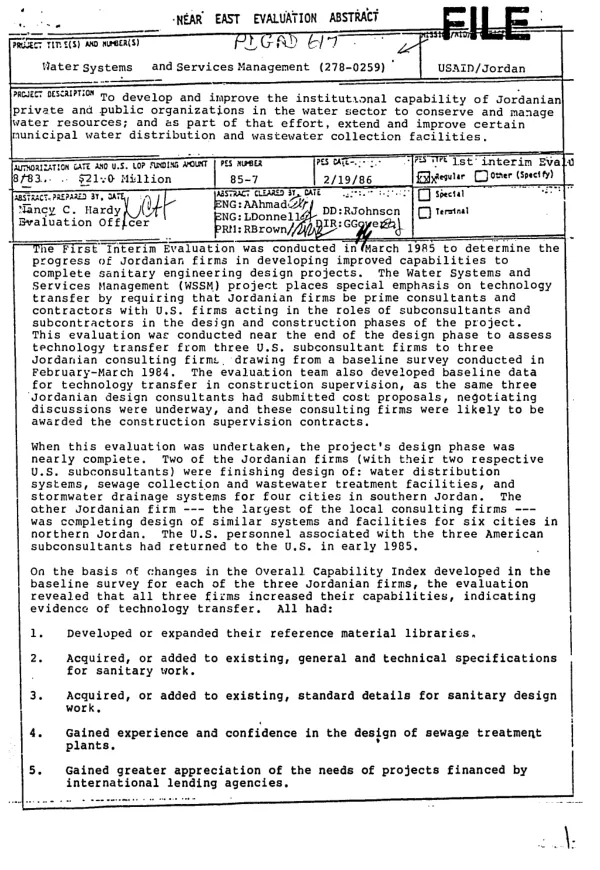
PES covers the period 8/83-3/85, is based on document review and discussions with Jordanian and U.S. project personnel, and focuses on the progress made by three U.S. firms in transferring sanitation engineering technology to three Jordanian firms. Technology transfer has been extremely successful. At the time of the evaluation, two of the Jordanian firms were completing designs of water distribution systems, sewage collection and wastewater treatment facilities, and stormwater drainage systems in four cities in southern Jordan. The other firm, which is also the largest, was completing the design of similar systems and facilities for six cities in northern Jordan. The U.S. personnel associated with the three subconsultants returned to the United States in early 1985. The 2-3/84 baseline survey revealed that all three firms have increased their capability to complete sanitaton engineering design projects. All had: (1) developed or expanded reference material libraries; (2) acquired or expanded general and technical specifications for sanitary work and standard details for sanitary design work; (3) gained experience and confidence in designing sewage treatment plants; and (4) grown in appreciation of the needs of projects financed by international lending agencies. Of the means used to transfer the technology, one-on-one working opportunities proved the most effective and studying outside the work environment the least effective approach. The extent to which the transferred technology will be retained depends on the firms" ability to obtain additional sanitary design contracts. Lessons learned are that: (1) technology transfer activities should be well-defined and implemented on a planned schedule which includes interim as well as long-term goals and deliverable items; (2) training activities such as participatory workshops and problemsolving sessions should be encouraged; and (3) major technology transfer efforts, especially in nontechnical areas, should continue to be grant-funded. (NE Bureau abstract, modified)