USAID DEC
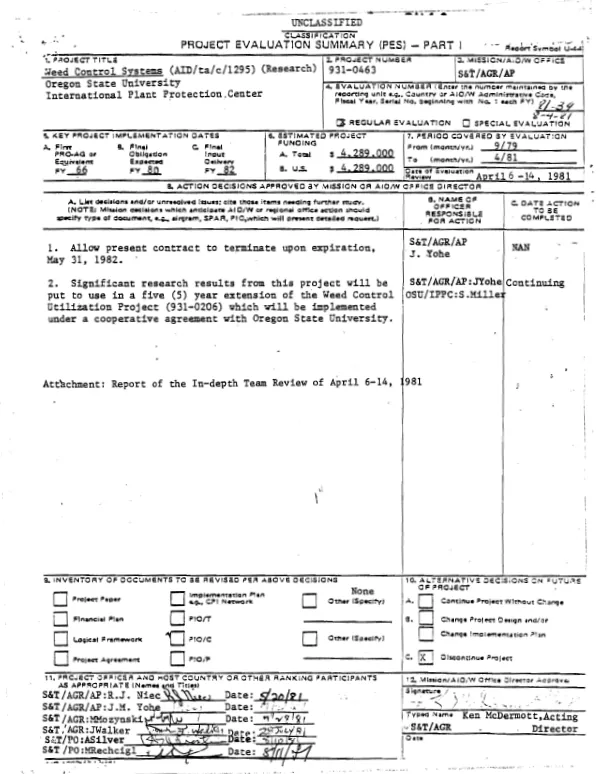
WEED CONTROL SYSTEMS UTILIZATION FOR REPRESENTATIVE FARMS IN DEVELOPING COUNTRIES (8/21/78-8/25/78)
Sign inUSAID. BUR. FOR DEVELOPMENT SUPPORT. OFC. OF AGRICULTURE
WEED CONTROL SYSTEMS UTILIZATION FOR REPRESENTATIVE FARMS IN DEVELOPING COUNTRIES (8/21/78-8/25/78)
Evaluates project to improve weed control in LDC"s from 7/1/77 to 7/1/78.
1978
Sign in to readA free account is required to download.
Abstract
Evaluation was conducted through on-site visits to CATIE and the 2 participating universities -- University of Florida and Oregon State Univ. Counterpart training was provided to 31 persons in South America, 20 in Central America, 144 in Asia and the Pacific Islands, and 5 in Africa. Several weed science societies were formed with OSU encouragement. In addition, "Infoletter" (in its 9th year of publication) is being sent to nearly 4000 recipients in more than 120 countries. Weed research manuals have been published in both English and Spanish. Aquatic weed control problems were assessed in Nicaragua and Thailand, and preliminary work has begun in Chad. Also, the information retrieval system is now ready to provide references on the world"s literature on aquatic weeds and their control. Progress is noted in Central America. Systems of no-till corn and bean production were developed using mulches and a minimum of capital, and farmers are adapting the methods of weed control which prove best in experiments. Lessons learned include the following: 1) socio-economic factors are important in implementing weed control systems; 2) the no-till system such as that used in Costa Rica, may be used with modifications to solve problems in other climatic situations. Evaluators recommend that greater emphasis be placed upon socio-economic information in the aquatic program, ie losses caused by aquatic weeds and the effects of control measures.