USAID DEC
Well-Ordered Trimeric HIV-1 Subtype B and C Soluble Spike Mimetics Generated by Negative Selection Display Native-like Properties
Sign inUSAID DEC
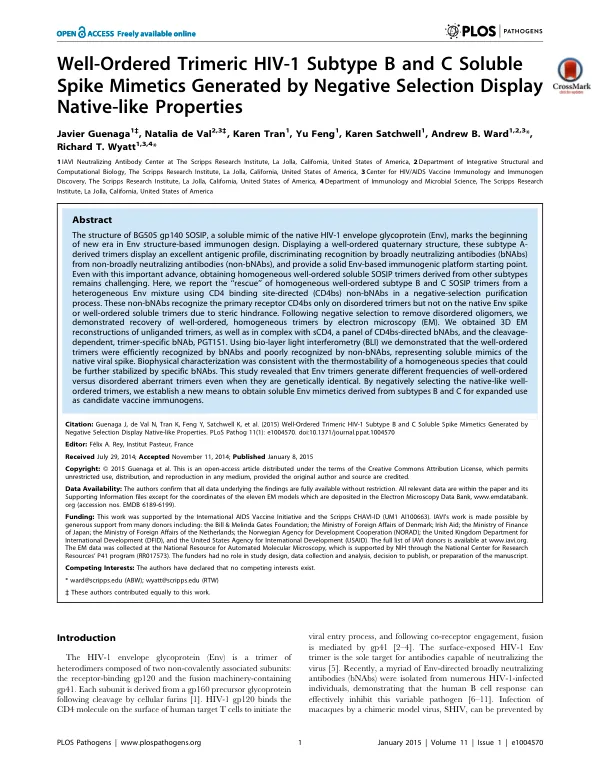
Well-Ordered Trimeric HIV-1 Subtype B and C Soluble Spike Mimetics Generated by Negative Selection Display Native-like Properties
The HIV-1 envelope glycoprotein (Env) is a trimer of heterodimers composed of two non-covalently associated subunits: the receptor-binding gp120 and the fusion machinery-containing gp41.
2015 · 16 pages
Sign in to readA free account is required to download.
Abstract
Each subunit is derived from a gp160 precursor glycoprotein following cleavage by cellular furins. HIV-1 gp120 binds the CD4 molecule on the surface of human target T cells to initiate the viral entry process, and following co-receptor engagement, fusion is mediated by gp41. The surface-exposed HIV-1 Env trimer is the sole target for antibodies capable of neutralizing the virus. Recently, a myriad of Env-directed broadly neutralizing antibodies (bNAbs) were isolated from numerous HIV-1-infected individuals, demonstrating that the human B cell response can effectively inhibit this variable pathogen. Infection of macaques by a chimeric model virus, SHIV, can be prevented by prior passive immunization of all bNAbs so far tested, confirming the capacity of neutralizing antibodies to prevent HIV infection. An efficacious HIV-1 vaccine would likely need to generate bNAbs targeting Env, but the difficulty to vaccinate against HIV arises from the extensive variability of Env present on the large number of HIV-1 isolates simultaneously circulating in the human population as well as other mechanisms of immune evasion selected for by strong pressure from the human immune system. Many Env-based trimeric candidate immunogens are engineered to eliminate cleavage between gp120 and gp41 (so-called uncleaved gp140 trimers), usually generating imperfect mimetics of the functional spike based on antigenic profiling or EM analysis. As a group, the defined, or presumed to be, disordered trimers (in adjuvant) generate high self-binding antibody titers. However, these vaccine-elicited antibodies do not efficiently neutralize most HIV-1 primary isolates, that is, strains representative of those circulating in the human population. Antibodies elicited by these immunogens target epitopes exposed only on the free gp120 and trimeric post-fusion forms of gp41 or disordered gp140s and thus are ineffective at accessing their epitopes buried within the ordered, quaternary structure achieved in the native Env spike. The BG505 gp140 SOSIP, a soluble mimic of the native HIV-1 envelope glycoprotein (Env), marks the beginning of a new era in Env structure-based immunogen design. Displaying a well-ordered quaternary structure, these subtype A-derived trimers display an excellent antigenic profile, discriminating recognition by broadly neutralizing antibodies (bNAbs) from non-broadly neutralizing antibodies (non-bNAbs), and provide a solid Env-based immunogenic platform starting point. However, obtaining homogeneous well-ordered soluble SOSIP trimers derived from other subtypes remains challenging. Researchers have developed a negative-selection purification process using CD4 binding site-directed (CD4bs) non-bNAbs to "rescue" homogeneous well-ordered subtype B and C SOSIP trimers from a heterogeneous Env mixture. These non-bNAbs recognize the primary receptor CD4bs only on disordered trimers but not on the native Env spike or well-ordered soluble trimers due to steric hindrance. Following negative selection to remove disordered oligomers, researchers demonstrated recovery of well-ordered, homogeneous trimers by electron microscopy (EM). The well-ordered trimers were efficiently recognized by bNAbs and poorly recognized by non-bNAbs, representing soluble mimics of the native viral spike.
Related documents
Documents in this collection
 2012
2012USAID DEC
A Single Dose of a MIV-150/Zinc Acetate Gel Provides 24 h of Protection Against Vaginal Simian Human Immunodeficiency Virus Reverse Transcriptase Infection, with More Limited Protection Rectally 8–24 h After Gel Use
Open record 2012
2012USAID DEC