DELOITTE CONSULTING, LLP
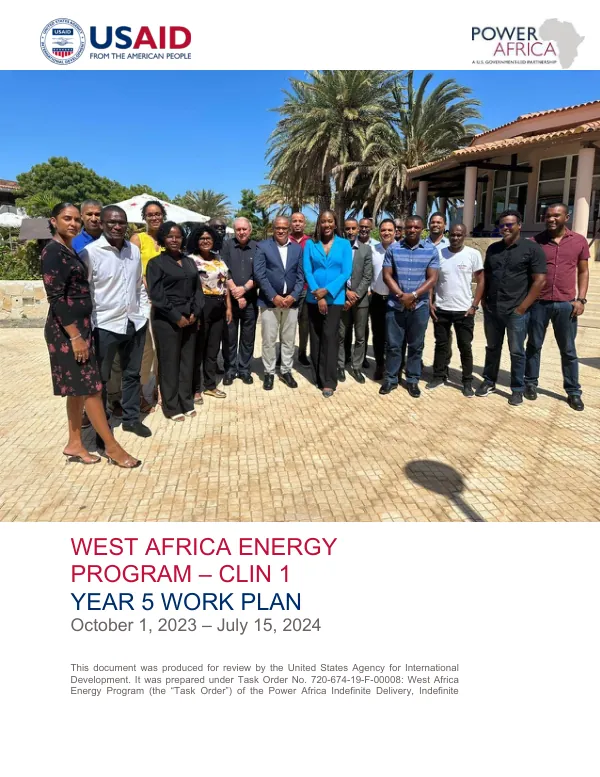
West Africa Energy Program – CLIN 2 Year 1 Work Plan
The West Africa Energy Program (WAEP) is a USAID-funded initiative aimed at improving the energy sector in Ghana.
2019 · 105 pages
Sign in to readA free account is required to download.
Abstract
The program is implemented under Task Order 720-674-19-F00008, which is part of the Indefinite Delivery, Indefinite Quantity (IDIQ) Contract No. 720-674-18-D-00003. The program is managed by Deloitte Consultancy. The WAEP has identified several key objectives, including increasing the supply of power, improving the legal and regulatory frameworks, and enhancing the social and environmental sustainability of power projects. The program also aims to increase access to reliable and affordable power, improve the performance of national utilities and sector entities, and enhance the capacity of regulators to enable solvents and reliable power systems. The program's theory of change is based on the assumption that improved energy access and reliability will lead to increased economic growth, poverty reduction, and improved living standards. The results framework outlines six intermediate results (IR) for each of the three outcomes, which are: Outcome 1: Optimized Supply of Power * IR 1.1: New generation capacity and non-generation energy services are advanced. * IR 1.2: Generation and transmission planning is improved. * IR 1.3: Legal and regulatory frameworks for private sector participation are improved. * IR 1.4: Financing solutions are made more accessible. * IR 1.5: Transmission capacity is strengthened. * IR 1.6: Social and environmental sustainability of power projects is strengthened. Outcome 2: Access to Reliable and Affordable Power Increased * IR 2.1: Electrification planning is optimized. * IR 2.2: Financing solutions for distribution infrastructure are improved. * IR 2.3: Ease and affordability of end-user connections are improved. Outcome 3: Performance of National Utilities and Sector Entities Improved * IR 3.1: Effectiveness of regulators to enable solvents and reliable power systems is improved. * IR 3.2: Performance and financial viability of electric utilities are improved. * IR 3.3: Relevant capacity to manage the power sector is improved. The program's implementation is guided by a year-long work plan, which outlines the key activities, milestones, and milestones for each outcome. The program's staffing includes a Chief of Party, a Deputy Chief of Party, and a team of technical advisors and consultants. The program's budget is approximately $10 million, which will be used to support the implementation of the program's activities and outcomes. The program's duration is 5 years, with a start date of July 2019 and an end date of June 2024. The program's success will be monitored and evaluated through a series of indicators, which will be tracked and reported on a quarterly basis. The program's progress will also be reviewed and adjusted as necessary to ensure that the program is meeting its objectives and outcomes. The program's implementation will be supported by a range of stakeholders, including the Government of Ghana, the private sector, civil society organizations, and international development partners. The program's success will depend on the effective collaboration and coordination of these stakeholders, as well as the program's ability to adapt to changing circumstances and challenges.
Related documents