THE WORLD BANK
West Africa RAPID
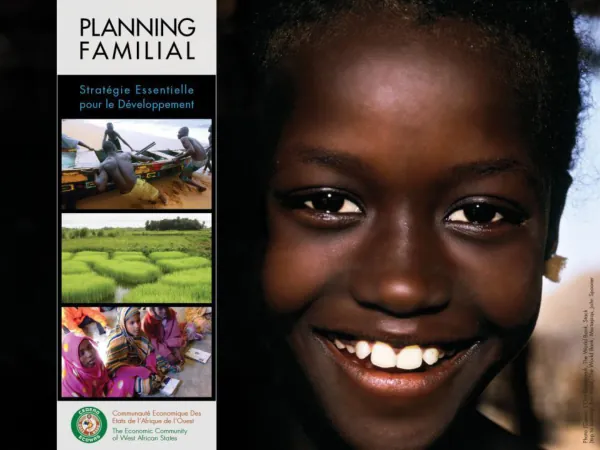
The West Africa Health Organization has developed a strategy for familial planning, titled "Planning Familial: Stratégie Essentielle pour le Développement."
2011 · 33 pages
Sign in to readA free account is required to download.
Abstract
This initiative aims to address the pressing issue of population growth in West Africa, where the population has tripled over the past 40 years. The region's population is projected to continue growing, with a total of 21.6 million inhabitants in Côte d'Ivoire, 16.3 million in Burkina Faso, and 15.9 million in Niger, among others. The population growth rate is driven by high birth rates, with 1 in 4 women desiring to space or limit their births but not using contraception. The total fertility rate (TFR) varies across countries, ranging from 4-5 children per woman in Niger and Mali to 5-6 children per woman in Burkina Faso and Côte d'Ivoire. The strategy emphasizes the importance of increasing access to modern family planning (PF) methods, which are more effective than traditional methods. The current contraceptive prevalence rate (CPR) is 13% in Benin, 17% in Burkina Faso, and 27% in Côte d'Ivoire. The organization aims to increase the CPR to 60% by 2030, which would significantly reduce the population growth rate. The strategy identifies two possible scenarios for population growth: the current trend, where contraceptive use increases modestly, and the optimal scenario, where all women who desire to space or limit their births use contraception by 2030. The latter scenario would lead to a significant reduction in population growth, with a total population of 9 million in Benin, 12 million in Burkina Faso, and 11 million in Côte d'Ivoire by 2030. The West Africa Health Organization's strategy for familial planning aims to address the pressing issue of population growth in the region by increasing access to modern family planning methods and promoting their use among women. By achieving the optimal scenario, the organization hopes to reduce the population growth rate and improve the overall well-being of the population.