UNITED STATES DEPARTMENT OF STATE
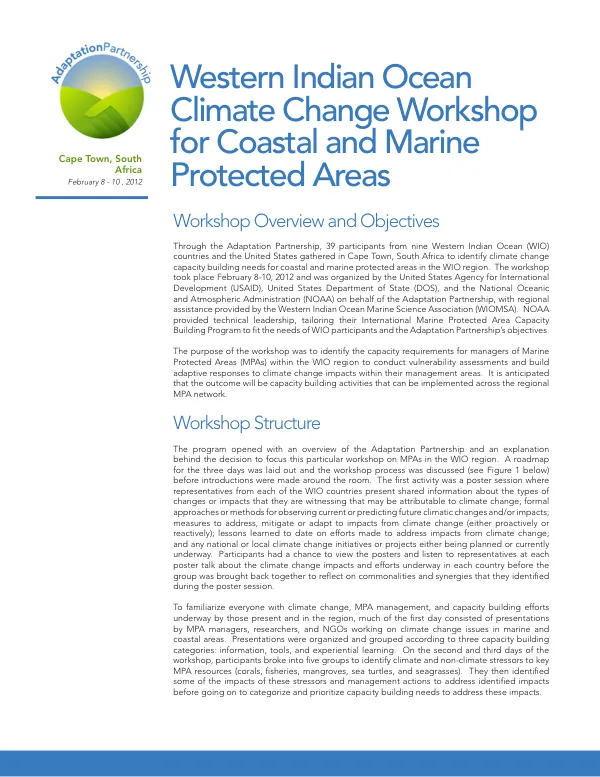
Western Indian Ocean Climate Change Workshop for Coastal and Marine Protected Areas
The Western Indian Ocean Climate Change Workshop for Coastal and Marine Protected Areas was held in Cape Town, South Africa from February 8-10, 2012.
2012 · 6 pages
Sign in to readA free account is required to download.
Abstract
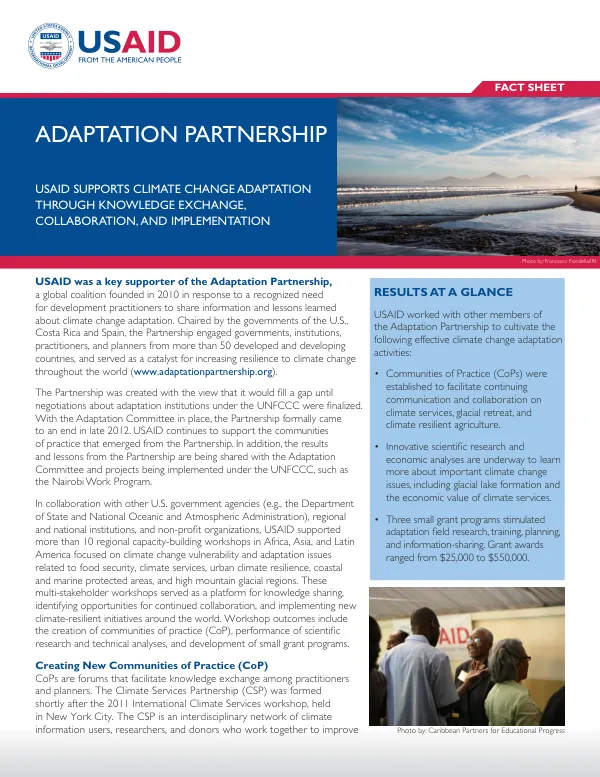
The workshop brought together 39 participants from nine Western Indian Ocean (WIO) countries and the United States to identify climate change capacity building needs for coastal and marine protected areas in the WIO region. The workshop was organized by the United States Agency for International Development (USAID), United States Department of State (DOS), and the National Oceanic and Atmospheric Administration (NOAA) on behalf of the Adaptation Partnership, with regional assistance provided by the Western Indian Ocean Marine Science Association (WIOMSA). The purpose of the workshop was to identify the capacity requirements for managers of Marine Protected Areas (MPAs) within the WIO region to conduct vulnerability assessments and build adaptive responses to climate change impacts within their management areas. The workshop aimed to identify capacity building activities that can be implemented across the regional MPA network. The workshop process involved a series of presentations, group discussions, and activities to identify climate and non-climate stressors to key MPA resources, including corals, fisheries, mangroves, sea turtles, and seagrasses. The workshop participants were divided into five groups to work through a series of worksheets to help identify capacity building needs. Each group identified climate change impacts on a target resource and capacity building needs to address these impacts. The findings of each group on the most immediate capacity building needs for their target resource are summarized below. The corals group identified non-climate stressors threatening corals as activities related to fishing, coral extraction, snorkeling, and land use. Existing management approaches to combat these stressors include education and raising awareness about the destruction of coral, monitoring the impact of stressors on the health of corals, and protecting corals by limiting access with zoning, permits, and enforcement. The group identified potential climate change stressors, including more frequent and/or more intense storms, increases in air and water temperatures, and increased precipitation, which may increase turbidity and disease outbreaks in coral communities. The capacity needs most critical to improving the management of climate change impacts on corals were identified as improved education and awareness tools and training, improved data, information, and tools to better understand climate change impacts and vulnerabilities, and an assessment of effective management techniques. The fisheries group identified three main fishing subcategories and the main non-climate stresses to their resource within these as destructive practices, unsustainable harvesting strategies, and overfishing driven by increased demand, greater fishing effort, and improved gear/techniques. Current management measures, such as establishing no-take areas, limiting catch allowances, and restricting the type of gear allowed, are only as good as the resources available for patrolling and enforcement. The group identified climate stressors, including changes in precipitation patterns and sea temperature, ocean acidification, and increased and/or more intense storm events, which may impact fish habitat, population, and diversity. The capacity needs that need to be filled to better implement management approaches for fisheries were identified as improved information about the health of fisheries through training and tools for data collection and monitoring, enhanced resilience through better site-specific information and a reference guide of response techniques, strengthened capacity to communicate MPA concerns and needs, and improved ability of those receiving the information from MPA managers to understand and act on this information. The workshop findings and recommendations will inform the development of capacity building activities to address climate change impacts on coastal and marine protected areas in the WIO region. The outcomes of the workshop will contribute to the implementation of the Adaptation Partnership's objectives and the development of a regional MPA network that is resilient to climate change impacts.
Related documents