USAID DEC
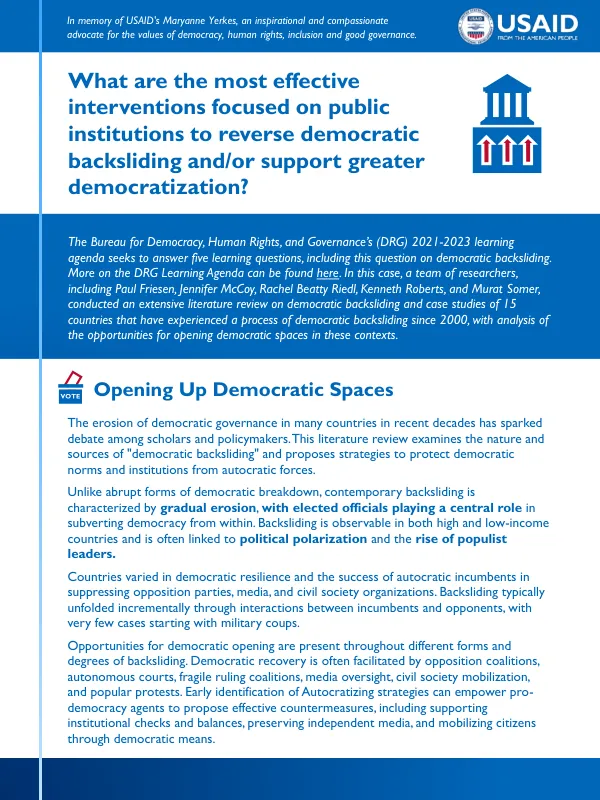
What are the most effective interventions focused on public institutions to reverse democratic backsliding and/or support greater democratization?
Sign inNORC AT THE UNIVERSITY OF CHICAGO
What are the most effective interventions focused on public institutions to reverse democratic backsliding and/or support greater democratization?
The erosion of democratic governance in many countries has sparked debate among scholars and policymakers.
2023 · 2 pages
Sign in to readA free account is required to download.
Abstract
Democratic backsliding is characterized by gradual erosion, with elected officials playing a central role in subverting democracy from within. This phenomenon is observable in both high and low-income countries and is often linked to political polarization and the rise of populist leaders. Backsliding typically unfolds incrementally through interactions between incumbents and opponents, with very few cases starting with military coups. Countries varied in democratic resilience and the success of autocratic incumbents in suppressing opposition parties, media, and civil society organizations. Opportunities for democratic opening are present throughout different forms and degrees of backsliding. Democratic recovery is often facilitated by opposition coalitions, autonomous courts, fragile ruling coalitions, media oversight, civil society mobilization, and popular protests. Early identification of autocratizing strategies can empower pro-democracy agents to propose effective countermeasures, including supporting institutional checks and balances, preserving independent media, and mobilizing citizens through democratic means. Key strategies for protecting democratic norms and institutions from autocratic forces include strengthening democratic support through responsible media consumption, positive social contacts, involvement in pro-democracy civil society, and local political engagement. Additionally, depolarization and reducing polarization can help block or minimize backsliding. This can be achieved through systems that reduce extremism and violence, such as proportional representation electoral systems. In terms of institutional checks and balances, maintaining independence is crucial for the judiciary, legislature, and bureaucratic agencies. This can be achieved through a strong judicial support network, peer-controlled appointment processes, limiting new auxiliary court systems, and grounding judicial autonomy in the constitution. Similarly, executive accountability can be promoted through opposition control of legislative chambers, internal divides in the ruling party, mass public movements against the executive, and a history of institutional independence in the legislature. Furthermore, protecting media freedoms and widespread access to information is essential for democratic backsliding prevention. This can be achieved through reducing polarization, managing social media fragmentation, increasing publicly-funded media, media literacy efforts, and transparency from social media companies. Civil society also plays a crucial role in pushing back against anti-democratic leaders while minimizing further polarization through non-violent protest, alliance building, seeking accountability through legal channels, mass mobilization in response to anti-democratic actions, and focusing on valence issues and shared identities.