USAID DEC
What dimensions of women’s empowerment in agriculture matter for nutrition in Ghana?
Sign inELSEVIER LTD.
What dimensions of women’s empowerment in agriculture matter for nutrition in Ghana?
Women's empowerment in agriculture is a critical factor in improving nutrition outcomes for women and children in Ghana.
2015 · 10 pages
Sign in to readA free account is required to download.
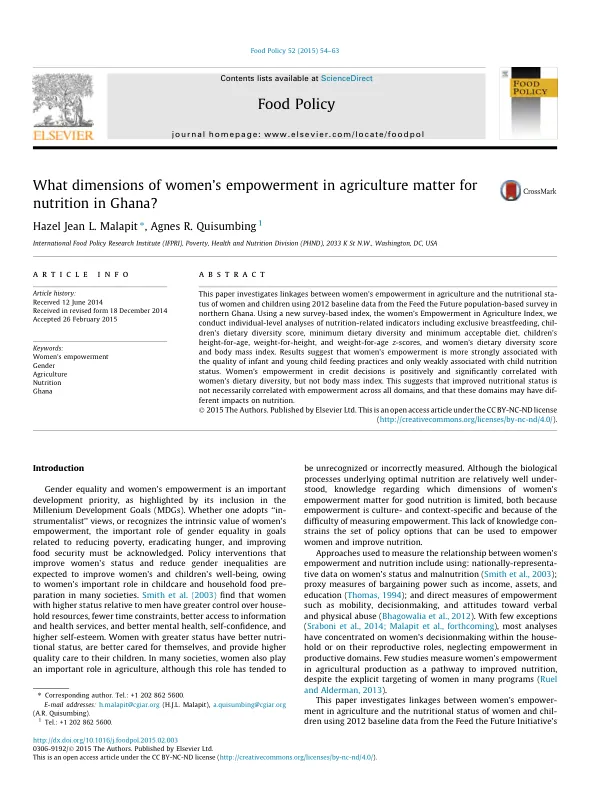
Abstract
The Women's Empowerment in Agriculture Index (WEAI) is a new survey-based tool designed to measure the empowerment, agency, and inclusion of women in agriculture. The index is composed of two subindexes: the five domains of empowerment (5DE) and the gender parity index (GPI). The 5DE assesses the degree to which women are empowered in five domains, including agricultural production decisions, access to and decisionmaking power over productive resources, control over use of income, leadership roles within the community, and time allocation. The WEAI is an aggregate index reported at the program level and is constructed from individual-level empowerment scores, which reflect each person's achievements in the five domains as measured by 10 indicators with their corresponding weights. Each indicator measures whether an individual has surpassed a given threshold or has adequate achievement with respect to each indicator. A woman is defined as empowered if she has adequate achievements in four out of the five domains or has achieved adequacy in 80% or more of the weighted indicators. The study uses 2012 baseline data from the Feed the Future population-based survey in northern Ghana to investigate linkages between women's empowerment in agriculture and the nutritional status of women and children. The analysis focuses on the women's empowerment score to assess the extent to which women's empowerment in agriculture is linked with the adoption of infant and young child feeding (IYCF) practices and nutrition outcomes for women and children. The study also uses the components of the women's empowerment score to identify how specific domains and indicators are associated with nutrition. The results suggest that women's empowerment is more strongly associated with the quality of infant and young child feeding practices and only weakly associated with child nutrition status. Women's empowerment in credit decisions is positively and significantly correlated with women's dietary diversity, but not body mass index. This suggests that improved nutritional status is not necessarily correlated with empowerment across all domains, and that these domains may have different impacts on nutrition. The study also examines relationships between intrahousehold inequality and nutrition in households where both male and female decisionmakers are present. The analysis reveals that different domains of empowerment may have different impacts on nutrition, consistent with other findings in the empowerment literature. The study highlights the importance of considering the specific domains and indicators of empowerment when assessing their impact on nutrition outcomes. In Ghana, children's nutritional status has improved in recent years, although the stunting prevalence remains high at 23%. The country has experienced relatively high rates of economic growth and poverty reduction in the past two decades, although poverty reduction has been much slower in the north. The study's findings have implications for policy interventions aimed at improving women's empowerment and nutrition outcomes in Ghana and other countries.