USAID DEC
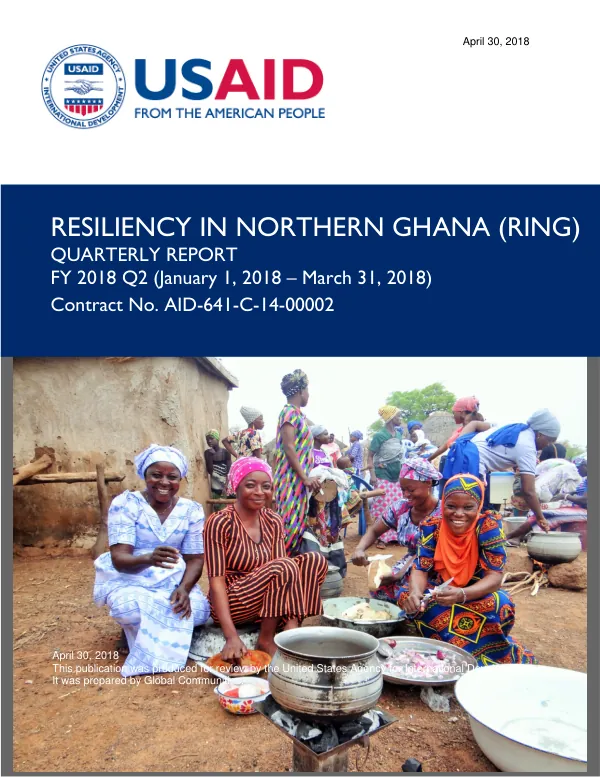
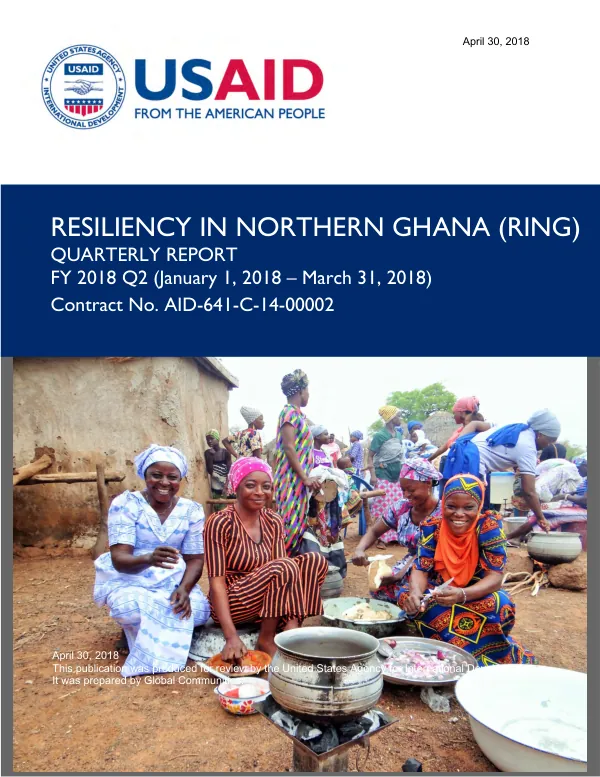
Resiliency in Northern Ghana (RING) Quarterly Report FY 2018 Q3 (April 1, 2018 – June 30, 2018)
Sign inGLOBAL COMMUNITIES
Resiliency in Northern Ghana (RING) Quarterly Report FY 2018 Q3 (April 1, 2018 – June 30, 2018)
Resiliency in Northern Ghana (RING) is a program aimed at improving the livelihoods of rural communities in the Northern Region of Ghana.
2018 · 83 pages
Sign in to readA free account is required to download.
Abstract
The program is implemented by Global Communities and is funded by the United States Agency for International Development (USAID). The program's primary objective is to enhance the resilience of rural communities to climate-related shocks and stresses. The program focuses on three key components: Component One, Component Two, and Component Three. Component One aims to improve agricultural productivity and market access for smallholder farmers. This is achieved through the establishment of Village Savings and Loans Associations (VSLAs) and the provision of training and support to farmers on improved agricultural practices. Component Two focuses on improving nutrition and health outcomes for vulnerable populations, including children, pregnant women, and people living with HIV/AIDS. This is achieved through the implementation of community-based management of acute malnutrition (CMAM) and the promotion of improved nutrition practices. Component Three aims to improve water, sanitation, and hygiene (WASH) services in rural communities, with a focus on increasing access to safe drinking water and improving sanitation facilities. The program has made significant progress in the first quarter of FY 2018. A total of 2,500 farmers have been trained on improved agricultural practices, and 1,500 VSLAs have been established. The program has also distributed 10,000 orange-fleshed sweetpotato (OFSP) vines to farmers, with a total of 5,000 households benefiting from the distribution. In terms of nutrition, the program has supported the treatment of 1,500 children with severe acute malnutrition (SAM) and has provided nutrition education to 2,000 pregnant women and lactating mothers. The program has also made significant progress in improving WASH services, with a total of 500 households benefiting from improved sanitation facilities and 200 households benefiting from improved access to safe drinking water. The program has also made significant progress in terms of monitoring and evaluation. The program has established a robust monitoring and evaluation system, which includes regular data collection and analysis. The program has also established a quality assurance system, which ensures that all program activities are implemented in accordance with established standards and protocols. The program has also made significant progress in terms of social behavior change communication (SBCC). The program has implemented a range of SBCC activities, including the dissemination of advocacy videos and the provision of training to community health workers on improved nutrition practices. The program has also established a network of natural leaders, who are trained to promote improved nutrition practices and provide support to vulnerable populations. The program has also made significant progress in terms of risk-based internal audit (RBIA). The program has established a robust RBIA system, which includes regular audits and assessments of program activities. The program has also established a resource and financial management improvement committee (ReFMIC), which is responsible for ensuring that all program activities are implemented in accordance with established financial and management protocols. The program has also made significant progress in terms of private sector and development partner collaboration. The program has established partnerships with a range of private sector and development partners, including the Savannah Agricultural Research Institute (SARI) and the United Nations Children's Fund (UNICEF). The program has also established a business advisory center (BAC), which provides support to smallholder farmers on business planning and management. The program has also made significant progress in terms of community-led total sanitation (CLTS). The program has established a range of CLTS activities, including the promotion of improved sanitation practices and the provision of support to communities on sanitation facility construction. The program has also established a network of community-based health planning and services (CHPS) compounds, which provide health services to vulnerable populations. The program has also made significant progress in terms of school health education program (SHEP). The program has established a range of SHEP activities, including the provision of training to teachers on improved health education practices and the promotion of improved health behaviors among school children. The program has also established a network of school health clubs, which provide support to school children on health and nutrition practices. The program has also made significant progress in terms of strengthening partnerships, results, and innovations in nutrition globally (SPRING). The program has established a range of SPRING activities, including the provision of training to community health workers on improved nutrition practices and the promotion of improved nutrition behaviors among vulnerable populations. The program has also established a network of natural leaders, who are trained to promote improved nutrition practices and provide support to vulnerable populations. The program has also made significant progress in terms of systems for health (S4H). The program has established a range of S4H activities, including the provision of training to community health workers on improved health practices and the promotion of improved health behaviors among vulnerable populations. The program has also established a network of community-based health planning and services (CHPS) compounds, which provide health services to vulnerable populations. The program has also made significant progress in terms of water, sanitation, and hygiene (WASH) services. The program has established a range of WASH activities