USAID DEC
Challenges facing women in Northern agricultural supply chains & what can be done about them
Sign inINTERNATIONAL ORGANIZATION FOR MIGRATION
Challenges facing women in Northern agricultural supply chains & what can be done about them
Agricultural development in Northern Ghana is hindered by several challenges facing women in the region's agricultural supply chains.
2021 · 5 pages
Sign in to readA free account is required to download.
Abstract
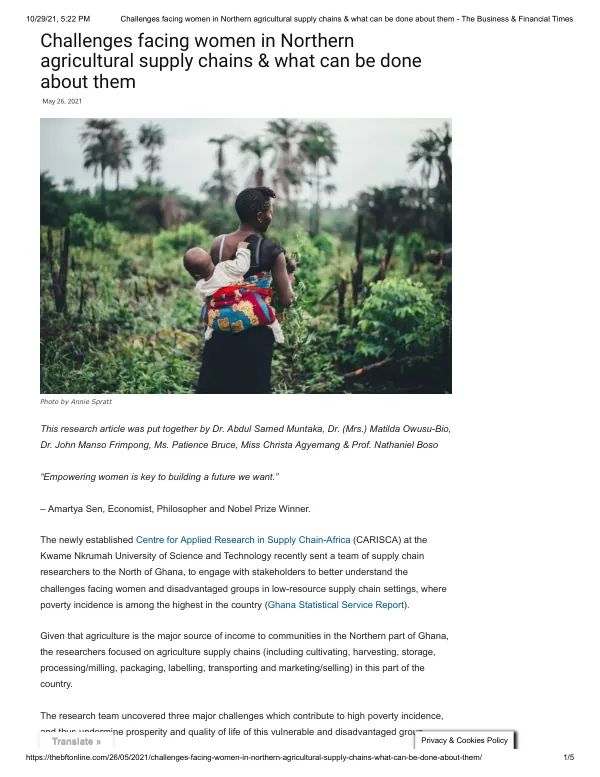
The Centre for Applied Research in Supply Chain-Africa (CARISCA) at the Kwame Nkrumah University of Science and Technology conducted research to identify these challenges and recommend solutions. Infrastructure inadequacy, obsolete machinery, and limited access to capital are major obstacles for women in the North of Ghana. Poor roads, unreliable power supply, and outmoded irrigation methods hinder agricultural production. Women face difficulties in procuring modern machinery and equipment for mechanized farming due to limited access to capital and credit. They often rely on wholesalers to sell their produce to markets in Southern Ghana, where profits are higher. However, many women's farming groups struggle to access capital to finance and market their produce. To address these challenges, innovative supply chain financing and corporate investments are needed. New policies and structures should be designed to give rural communities greater access to local financial services and capital. Building and protecting local investments and capital, lending circles, communal financing of capital-intensive machinery acquisition and servicing can help improve access to capital. National and local government authorities can take on the role of non-traditional capital suppliers to directly finance local enterprises, lands, and farms. Traditional gender roles also disenfranchise women's ability to be active decision-makers in the production and distribution of wealth generated by supply chains. Female participation and wealth gains are shaped at the household level by gendered divisions of labor, time budgets, and decision-making. To overcome these challenges, traditional economic models should be rethought to capture women's engagement in the workforce. Educational strategies should be developed and sustained to inform Ghanaian society about the benefits of women's participation and success in supply chains. Limited technological awareness, knowledge of market conditions, and supply chain educational opportunities have created market mismatches and subsequent waste. Only 20% of women in one farming community have access to a mobile phone, and those who do own a phone lack understanding of how to use it for business purposes. To address this challenge, supply chain training courses should be made available to women on their phones, teaching them how to process, package, and market their produce to generate additional revenue. The research team recommends leveraging new and existing knowledge and technology to improve women's access to information and skills. This can be achieved through mobile-based training courses, online platforms, and partnerships with local organizations. By addressing these challenges, women in Northern Ghana's agricultural supply chains can improve their livelihoods and contribute to the region's economic development.
Related documents