USAID
What is USAID and the STAR Partnership Assessment Toolkit
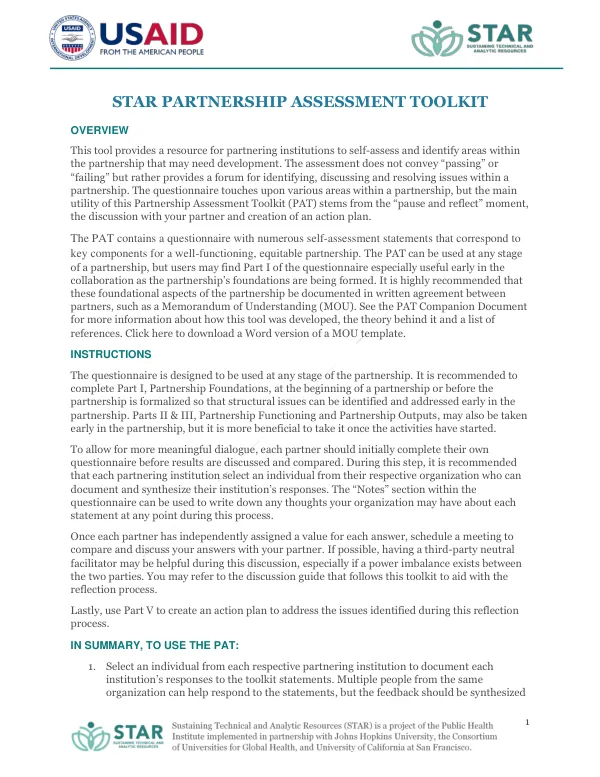
The Partnership Assessment Toolkit (PAT) is a resource for partnering institutions to self-assess and identify areas within the partnership that may need development.
2019 · 17 pages
Sign in to readA free account is required to download.
Abstract
The toolkit contains a questionnaire that assesses key components of a well-functioning partnership, including the partnership's foundations, functioning, and outcomes. The Bergen Model for Collaborative Functioning is used as a framework for assessing the partnership's foundations, which include the partnership's mission, partner resources, and financial resources. The model emphasizes the importance of sharing a mission and sharing resources, such as skills, connections, and funding, to ensure a successful partnership. The PAT questionnaire consists of 17 assessment statements, each with a score of 5, 4, 3, 2, or 1, indicating the level of agreement or disagreement with the statement. The statements cover various aspects of the partnership, including the partnership's vision, goals, objectives, and resources. The toolkit recommends that partners complete the questionnaire before the partnership is formalized, as this allows for early identification of potential issues and enables the partnership to address them before they become major problems. The questionnaire is designed to be used at any stage of the partnership, and partners can use the results to create an action plan to address any areas that need improvement. The PAT also emphasizes the importance of transparency and open communication in a partnership. Partners are encouraged to discuss their answers and discuss any issues that arise during the partnership. The toolkit provides a framework for partners to work together to identify and address potential issues and to develop a plan to achieve their objectives. The Bergen Model for Collaborative Functioning highlights the importance of shared resources, including skills, connections, and funding, in a partnership. The model also emphasizes the need for partners to have the necessary human, financial, and technological resources to pursue their objectives. The PAT is a useful tool for partnering institutions to assess their partnership and identify areas for improvement. By using the PAT, partners can work together to develop a plan to address any issues that arise and to achieve their objectives. The toolkit also provides a framework for partners to document their partnership agreement, including the partnership's mission, goals, and objectives. The agreement should outline how the partnership will operate, including how decisions will be made and how resources will be shared. The PAT is a valuable resource for partnering institutions to