USAID
WhatsApp: A Tool to Reach MSM in El Salvador, One Strategy that Works
The Combination Prevention Program for HIV in Central America, implemented by PSI/PASMO, utilizes a unique approach to reach and support men who have sex with men (MSM) in El Salvador.
1 pages
Sign in to readA free account is required to download.
Abstract
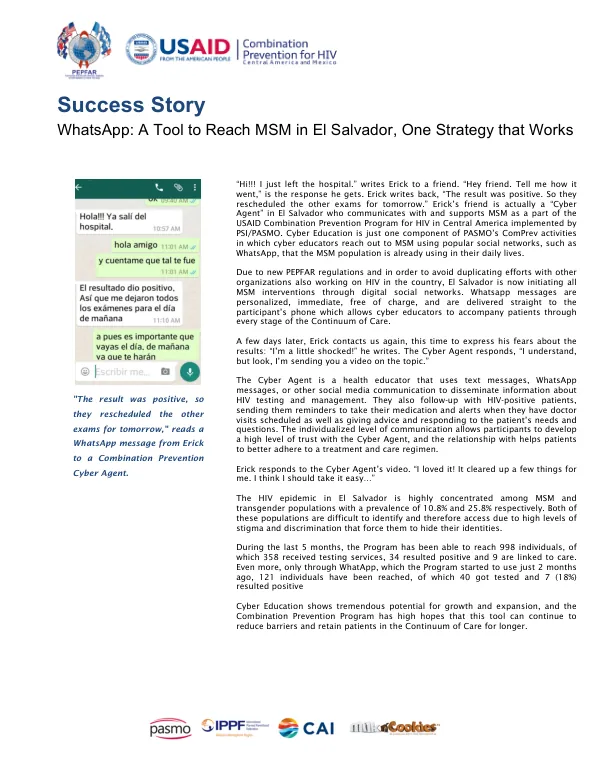
Cyber Education is a key component of this program, leveraging popular social networks such as WhatsApp to connect with MSM. Cyber Agents, trained health educators, communicate with participants through personalized, immediate, and free-of-charge messages, providing information on HIV testing and management, as well as follow-up support. This approach has shown significant potential in reaching and engaging MSM, a population that is difficult to identify and access due to high levels of stigma and discrimination. In the last 5 months, the program has reached 998 individuals, with 358 receiving testing services, 34 testing positive, and 9 linked to care. Notably, the use of WhatsApp, which was introduced just 2 months prior, has already yielded impressive results, with 121 individuals reached, 40 tested, and 7 (18%) testing positive. The program's success can be attributed to the individualized level of communication, which allows participants to develop a high level of trust with the Cyber Agents. This relationship enables patients to better adhere to treatment and care regimens, ultimately improving health outcomes. The program's focus on MSM and transgender populations, who are disproportionately affected by the HIV epidemic in El Salvador, is critical in addressing the country's high prevalence rates of 10.8% and 25.8%, respectively. The Combination Prevention Program's reliance on WhatsApp and other digital social networks has also helped to avoid duplicating efforts with other organizations working on HIV in the country. New PEPFAR regulations have necessitated this shift, and the program is now initiating all MSM interventions through digital social networks. This innovative approach has tremendous potential for growth and expansion, and the program is optimistic about its ability to reduce barriers and retain patients in the Continuum of Care for longer. The program's success is evident in the stories of individuals like Erick, who received support and guidance through WhatsApp messages. Erick's experience highlights the importance of personalized communication and follow-up support in improving health outcomes. The Combination Prevention Program's use of Cyber Education is a valuable strategy in reaching and supporting MSM in El Salvador, and its potential for growth and expansion is significant.