COLORADO STATE UNIVERSITY
Women in STEM: A Voluntary Peer Mentoring Model in Jordan
The voluntary peer-based mentoring program for women in STEM fields in Jordan aimed to address the challenges faced by female professors in balancing work and family responsibilities.
2021 · 1 pages
Sign in to readA free account is required to download.
Abstract
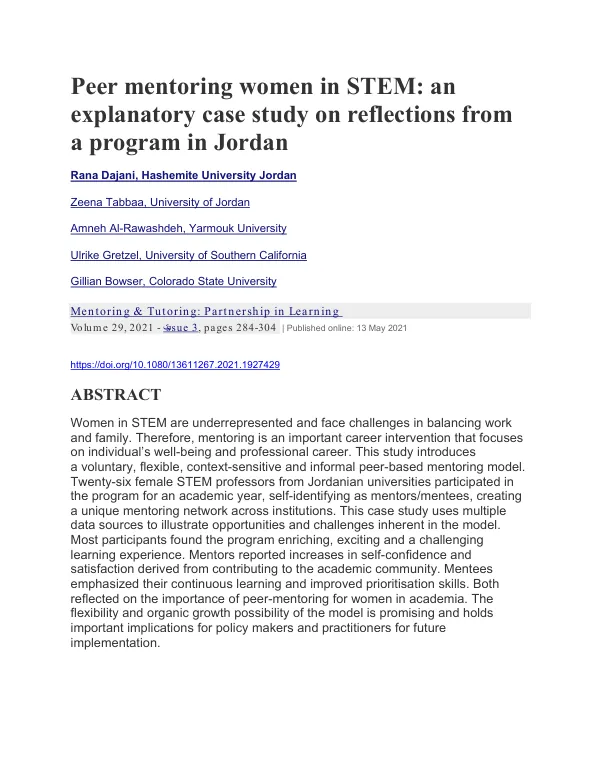
Twenty-six female professors from Jordanian universities participated in the program for an academic year, with each participant self-identifying as either a mentor or mentee. This created a unique network of peer mentors and mentees across institutions. The program's flexible and informal nature allowed participants to engage in mentoring activities at their own pace and in a way that suited their needs. Multiple data sources were used to illustrate the opportunities and challenges associated with this model. Participants reported a range of benefits, including increased self-confidence and satisfaction derived from contributing to the academic community. Mentors found the program to be an exciting and enriching experience, while mentees emphasized the importance of peer mentoring for their continued learning and improved prioritization skills. The program's flexibility and potential for growth were seen as key strengths. Participants appreciated the ability to adapt the program to their individual needs and circumstances. This flexibility allowed the program to evolve and change over time, making it a promising model for future implementation. The program's informal nature also facilitated the creation of a supportive community of peers who were able to share their experiences and share knowledge. The program's impact on the participants' personal and professional development was significant. Participants reported increased self-confidence and a greater sense of satisfaction with their work. The program also provided an opportunity for participants to develop new skills and knowledge, which they were able to apply in their own work. The program's focus on peer mentoring was seen as particularly beneficial for women in STEM fields, where traditional mentoring models may not be as effective. The program's findings have implications for policy makers and practitioners seeking to support the development of women in STEM fields. The program's flexible and informal nature makes it a promising model for future implementation, and its focus on peer mentoring highlights the importance of creating supportive communities of peers who can share their experiences and share knowledge. The program's success demonstrates the potential for peer-based mentoring to support the development of women in STEM fields and to address the challenges they face in balancing work and family responsibilities.