CARE
Women Lead in Emergencies Evaluation and Project Evidence, Niger
Women Lead in Emergencies (WLiE) is a global initiative implemented by CARE in five countries, including Niger.
2021 · 30 pages
Sign in to readA free account is required to download.
Abstract
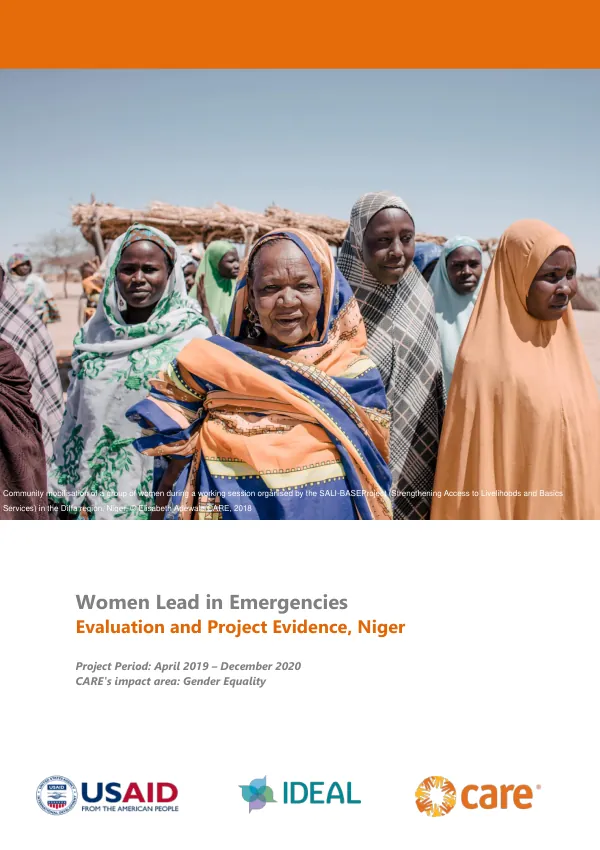
In Niger, the initiative is implemented in the departments of Maine (Diffa Region) and Dungass (Zinder Region) with the support of Norway and the Sall Family Foundation. The WLiE initiative aims to empower women to take leadership roles and participate meaningfully in decision-making processes. The evaluation of the WLiE initiative in Niger, conducted from April 2019 to December 2020, used innovative qualitative approaches combined with traditional methods of data collection and qualitative and quantitative analysis. The evaluation found that women have made significant changes in their leadership and participation, resulting in increased self-confidence, ability to participate and speak up in public meetings, and ability to take on leadership roles. A comparative analysis between women in WLiE-supported groups and those who were not supported by the project showed that women in WLiE-supported groups have significantly higher levels of responsible participation. Women in these groups have acquired leadership skills that allow them to speak out in decision-making bodies and public forums to express and defend their individual concerns and the concerns of their communities. Key findings from the evaluation include: * 96 percent of women in WLiE-supported groups participate in formal meetings, with 58 percent attending on a regular basis, compared to 79 percent and 34 percent of non-member women. * 77 percent of women members of WLiE-supported groups speak up to express their opinions and concerns in meetings, compared to 48.5 percent of non-members. * 71 percent of members and 34 percent of non-members report feeling listened to because their leaders take their opinions seriously. * 68 percent of female members and 46 percent of female non-members reported being able to hold leadership positions in their community. * Women in WLiE-supported groups have established working relationships with village chiefs, Imams, the Maine City Council, and NGOs to achieve their goals of improving their living conditions and the conditions of their communities. The evaluation also found that women collectively take action to implement community initiatives to address identified needs, and they influence and/or hold accountable community and humanitarian decision-makers for making changes to the humanitarian response, service delivery, or other aspects of their work. Perception of change by women and stakeholders showed that improving access to basic social services was most significant to women and men, receiving the highest score. However, the analysis also highlighted the social and familial costs of women's participation and leadership as an unintended negative effect of the project. Positive unexpected effects emerged, including the effect of women's leadership on other sectors and the driving role of women's advocacy on the effectiveness of coordination between actors. The result of an analysis of the level of participation of women, conducted by the women members of the WLiE groups, indicated that among the six groups that did the exercise, three report that they have increased their participation in decision-making processes.