USAID
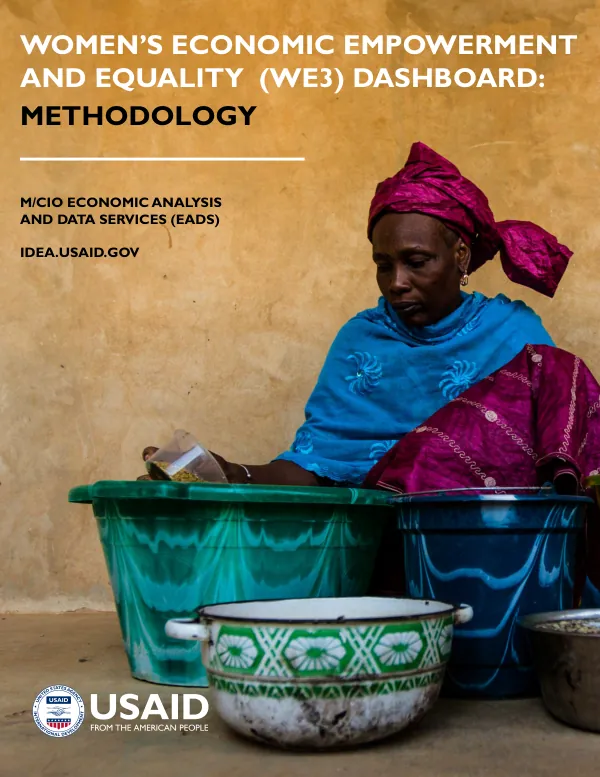
Women’s Economic Empowerment and Equality (WE3) Dashboard: Methodology
The Women’s Economic Empowerment and Equality (WE3) Dashboard is a joint effort between the United States Agency for International Development (USAID) and the Management Bureau’s Office of the Chief Information Officer (USAID/M/CIO) Economic Analysis and Data Services (EADS).
2018 · 7 pages
Sign in to readA free account is required to download.
Abstract
The Dashboard provides an overview of the situation of women in the economy, focusing on five key areas where women’s empowerment and equality are critical to the economic environment. These areas are referred to as Pillars, which include Access to Capital, Access to Markets, Innovation and Technology, Leadership, Voice, and Agency, and Skills, Capacity-Building, and Health. Each Pillar is comprised of three to five Dimensions, which are further broken down into Rescaled Indicators and Indicators. The Indicators are selected based on their validity, integrity, and reliability, and are sourced from reputable organizations such as the World Bank, UNESCO, WHO, and OECD. The Indicators are then analyzed to identify correlations and grouped into composite indicators, which simplify analysis and communication. The WE3 Dashboard uses a methodology that involves the following steps: selection of potential indicators, identification of Dimensions for each Pillar, and analysis of correlations among indicators. The team uses procedures such as calculating the correlation matrix, examining correlations, and examining correlations that are considered significant. The Cronbach Coefficient Alpha is also calculated to measure the share of total variability of the indicators that is attributable to the correlated latent component. The WE3 Dashboard is designed to be used as a tool to identify how countries are performing relative to each other in the area of women’s economic empowerment and equality. It is intended to be used by analysts, policymakers, monitoring specialists, researchers, and advocates to support their work in promoting women’s economic empowerment and equality. The Dashboard is updated annually on International Women’s Day, March 8th, and provides a comprehensive overview of the situation of women in the economy. The WE3 Dashboard has 18 Dimensions, which are grouped into five Pillars. Each Dimension is comprised of one to five Rescaled Indicators, which are used to measure women’s economic empowerment and equality. The Indicators are scaled between 0 and 5, with higher values indicating greater women’s economic empowerment and equality. The Dashboard also includes a list of all indicators used, which can be downloaded from the “About” section. The WE3 Dashboard is a valuable tool for promoting women’s economic empowerment and equality, and provides a comprehensive overview of the situation of women in the economy. It is designed to be used by a wide range of stakeholders, including analysts, policymakers, monitoring specialists, researchers, and advocates. The Dashboard is updated annually, providing up-to-date information on women’s economic empowerment and equality. The WE3 Dashboard is based on data from 2014-2016, with some indicators having missing values. To address this issue, the team estimated missing values and used the arithmetic average of the 2014-2016 period for each indicator, labeling it as 2017 on the Dashboard. The Dashboard also includes a list of all indicators used, which can be downloaded from the “About” section. The WE3 Dashboard is a joint effort between USAID and USAID/M/CIO EADS, and is designed to provide a comprehensive overview of the situation of women in the economy. It is intended to be used by a wide range of stakeholders, including analysts, policymakers, monitoring specialists, researchers, and advocates. The Dashboard is updated annually, providing up-to-date information on women’s economic empowerment and equality.