FOOD AND AGRICULTURE ORGANIZATION OF THE UNITED NATIONS IN GEORGIA
Women’s Land Rights and Women’s Economic Empowerment
Women's land rights and women's economic empowerment are critical components of USAID's development strategy.
2021 · 2 pages
Sign in to readA free account is required to download.
Abstract
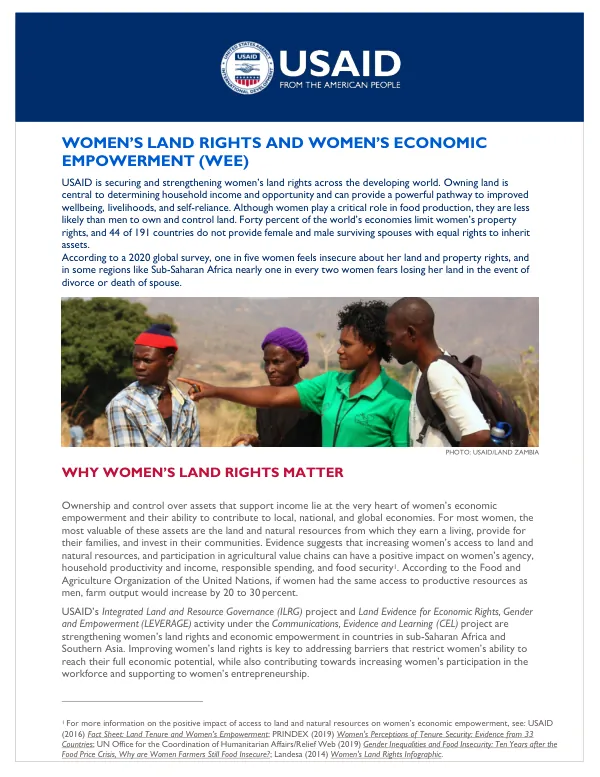
Securing and strengthening women's land rights across the developing world is essential for determining household income and opportunity, and can provide a powerful pathway to improved wellbeing, livelihoods, and self-reliance. Women play a critical role in food production, but are less likely than men to own and control land. Forty percent of the world's economies limit women's property rights, and 44 of 191 countries do not provide female and male surviving spouses with equal rights to inherit assets. According to a 2020 global survey, one in five women feels insecure about her land and property rights, and in some regions like Sub-Saharan Africa nearly one in every two women fears losing her land in the event of divorce or death of spouse. Ownership and control over assets that support income lie at the very heart of women's economic empowerment and their ability to contribute to local, national, and global economies. For most women, the most valuable of these assets are the land and natural resources from which they earn a living, provide for their families, and invest in their communities. Evidence suggests that increasing women's access to land and natural resources, and participation in agricultural value chains can have a positive impact on women's agency, household productivity and income, responsible spending, and food security. According to the Food and Agriculture Organization of the United Nations, if women had the same access to productive resources as men, farm output would increase by 20 to 30 percent. USAID's Integrated Land and Resource Governance (ILRG) project and Land Evidence for Economic Rights, Gender and Empowerment (LEVERAGE) activity under the Communications, Evidence and Learning (CEL) project are strengthening women's land rights and economic empowerment in countries in sub-Saharan Africa and Southern Asia. USAID's goal is to improve women's access to and control of land and natural resources for concrete economic, social, and political opportunities. Working with women, governments, traditional leaders, communities, and the private sector, USAID uses several strategies to achieve this goal. These strategies include supporting law and policy reforms to establish women's rights to land and natural resources, promoting gender integration in systematic land documentation processes, and providing training and promoting dialogues on harmful gender and social norms for customary leaders and communities. Additionally, USAID is providing women with the skills, knowledge, and resources to meaningfully participate in decision-making and governance related to land and natural resources, and engaging with the private sector to develop policies for gender-responsive land-based investment and business practices. USAID is also gathering and disseminating evidence, best practices, and lessons learned to inform governments, donors, and other stakeholders in developing new policies and programs to effectively strengthen women's rights and translate them into sustainable social and economic empowerment.
Related documents