USAID
Women’s Political Participation And Leadership Assessment Framework
Women's political participation and leadership is a critical component of advancing democracy and promoting gender equality worldwide.
2023 · 2 pages
Sign in to readA free account is required to download.
Abstract
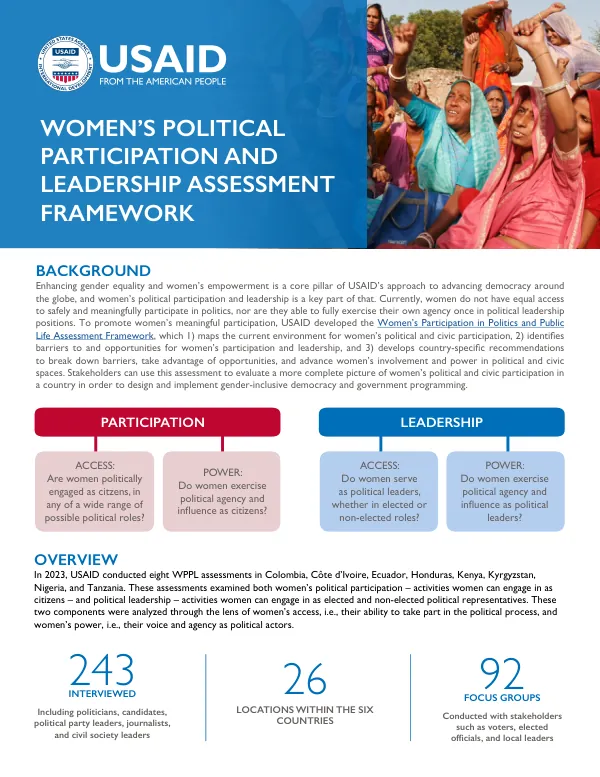
USAID's Women's Participation in Politics and Public Life Assessment Framework aims to map the current environment for women's political and civic participation, identify barriers and opportunities, and develop country-specific recommendations to break down barriers and advance women's involvement and power in political and civic spaces. The framework assesses women's political participation through two components: access and power. Access refers to women's ability to take part in the political process, while power refers to their voice and agency as political actors. The assessments examine both women's political participation as citizens and their political leadership as elected and non-elected representatives. In 2023, USAID conducted eight WPPL assessments in Colombia, Côte d'Ivoire, Ecuador, Honduras, Kenya, Kyrgyzstan, Nigeria, and Tanzania. These assessments analyzed the socio-cultural, institutional, and individual factors that shape opportunities and barriers for women to participate substantively in political life. The assessments found that restrictive gender norms and a patriarchal culture represent significant socio-cultural barriers to women's political participation and leadership. Violence against women in politics is a pervasive global issue that keeps women from participating in politics and staying involved. Programs must focus on strengthening existing laws to address this type of violence, working with key electoral stakeholders and party leaders on strategies to curb violence, and supporting women to bring perpetrators to justice and seek physical or psychological support. Political parties are key institutions that can provide opportunities for women's participation and leadership but can also be sites of exclusion. Political party leaders often control party funding, candidate selection, and party platforms, making decision-making behind closed doors and excluding women from real political opportunity and power. It is critical to work with political parties to ensure a gender-inclusive environment that values and promotes women's leadership. A lack of confidence, capacity, and connections to power and resources can deter women from participating in politics. There is a continued need to connect women with power and resources and build women's individual skills on a range of political topics, such as fundraising, policy development, and conflict mitigation. Prioritizing engagement with women outside the capital and those belonging to marginalized groups, such as Indigenous women, women with disabilities, and young women, is particularly important. The assessments explored three factors that shape opportunities and barriers for women to participate substantively in political life: socio-cultural factors, institutional factors, and individual factors. Socio-cultural factors include gender stereotypes, prevailing views on gender roles, and cultural ideas about gender equality. Institutional factors include the electoral system, political parties, and the broader political and legal context. Individual factors include women's levels of political capacity and resources and support for their political engagement. Women's experiences and perspectives on participating in politics are diverse and complex. A woman government official from Kyrgyzstan noted that women face high expectations from others and themselves, making it more difficult to enter and stay in politics. A woman political leader from Ecuador described the difficulty of staying in politics as one of the most difficult decisions of her life. A woman in civil society from Côte d'Ivoire highlighted the resilience and determination of women who have overcome significant obstacles to become members of parliament.