USAID DEC
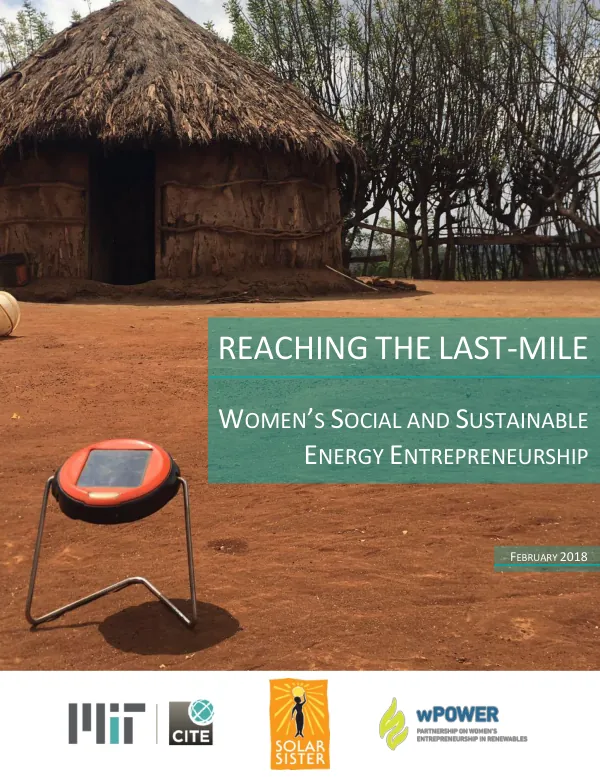
Women’s Social and Sustainable Energy Entrepreneurship: Reaching the Last-Mile
Rural Sub-Saharan Africa remains a region with sparse grid electricity coverage.
2018 · 26 pages
Sign in to readA free account is required to download.
Abstract
In Tanzania, the site of this study, only 15% of the population has access to electricity. A substantial urban bias exists, with 41% of the urban population having access to electricity, while only 4% do in rural areas, where 68% of the country's 55 million people live. Even in areas where grid electricity is accessible, it remains out of reach economically to low-income households, who find hefty connection fees and recurring monthly utility bills prohibitive. As a consequence, low-income households desire more lighting options, especially given the ongoing expenses associated with, and the health ramifications of, kerosene lamps, the predominant lighting source in rural Africa. The Government of Tanzania's efforts to provide for the energy needs of its citizenry have been met with some success, but issues of affordability and availability continue to pose significant challenges to rural development. This presents an opportunity for innovation and entrepreneurship, both in terms of technologies and service delivery models. Non-state actors have begun to try to fill this "energy gap" by providing rural households with various off-grid energy options, often in the form of solar lighting. Although some for-profit firms are engaged in trying to reach remote, "last-mile" households, the cost and effort of reaching them at scale remains a challenge. Further, one-off drives, campaigns, or giveaways, while certainly helpful to households in the short-term, do not address the structural barriers that continue to hinder people's sustained access to energy. A middle ground between a purely for-profit or purely philanthropic approach, social enterprises have emerged as a business model that can, in principle, reach those households most removed from the grid and who likely lack few electricity and energy alternatives. This study seeks to understand the impact of one such social enterprise in Tanzania, Solar Sister, in providing access to clean energy—in the form of household solar lanterns—to remote, rural areas, or what we call "last-mile” households throughout this report. Solar Sister's business model uses a network of trained women entrepreneurs—Solar Sister Entrepreneurs, or SSEs—to sell solar lanterns in their local communities. The argument for employing women in this way is not only that it promotes gender empowerment through economic opportunity, but also that such a model, where the salesperson is embedded in her community, reaches customers that other social enterprise and business models do not. The study's findings reveal that, first, based on a three-indicator last-mile index (LMI), Solar Sister is indeed reaching remote households. Second, rural customers in the areas where Solar Sister operates have few alternative options for clean energy. Solar Sister thus plays a crucial role in bringing clean energy to communities that other organizations are not reaching. Third, some indication exists of a bias against saleswomen, underscoring the role gender-conscious interventions may play in combatting such prejudice. Finally, rural customers appear to place considerable importance on the social aspects of a purchase, such as whether local after-sales service is available and whether a salesperson is someone familiar and trusted. This preference far exceeded even the financial consideration of paying for a product in installments, validating Solar Sister's approach to champion locally-embedded entrepreneurs. The study's research objectives and design were created and refined through an iterative process with Solar Sister staff in Washington, D.C. and Tanzania. Two research objectives drove the study: to determine the efficacy of social enterprises in reaching last-mile customers and to understand the preferences of rural residents when purchasing a small clean energy product. The study used a purposive sampling method to select Solar Sister customers and a random walk stratified by sub-village method to select non-customers in Solar Sister-adjacent villages. The study employed a survey with an embedded conjoint experiment to gather data on the preferences of rural residents. The study's findings have implications for the role of women in the energy sector in developing contexts and highlight the importance of considering the social aspects of a purchase when designing business models for clean energy distribution.